English
 Russian
 Turkce
 Arabian
 Chinese
AI in accounting: from month-end close to real-time financial reporting
Reconciliations, variance analysis and anomaly detection — how finance teams adopt AI and what still holds them back
Almost six in ten finance functions already use AI, and nearly every company expects it in financial reporting within three years. Here is where AI creates value in accounting today, which tools lead the market and what skills accountants need next.
Accounting has always been one of the most rule-based and data-rich functions in any organisation — which makes it a natural home for artificial intelligence. What has changed in the last two years is the arrival of generative AI on top of the automation that finance teams already knew. Machines now not only match transactions, but also explain variances in plain language, draft commentary and answer questions about the ledger.
- 58% of finance functions used AI in 2024, and 59% in 2025 (Gartner)
- 72% of companies already pilot or use AI in financial reporting; 99% expect to within three years (KPMG)
- 29% of chartered accountants already use generative AI in their jobs (Chartered Accountants Worldwide / Ipsos, 2025)
The adoption curve
Gartner's annual survey of finance leaders shows that AI moved into the mainstream of finance in 2024, when 58% of finance functions reported using it. In 2025 the figure held steady at 59% — a sign that the first wave of easy adoption is over and the hard part, scaling AI across processes, has begun.
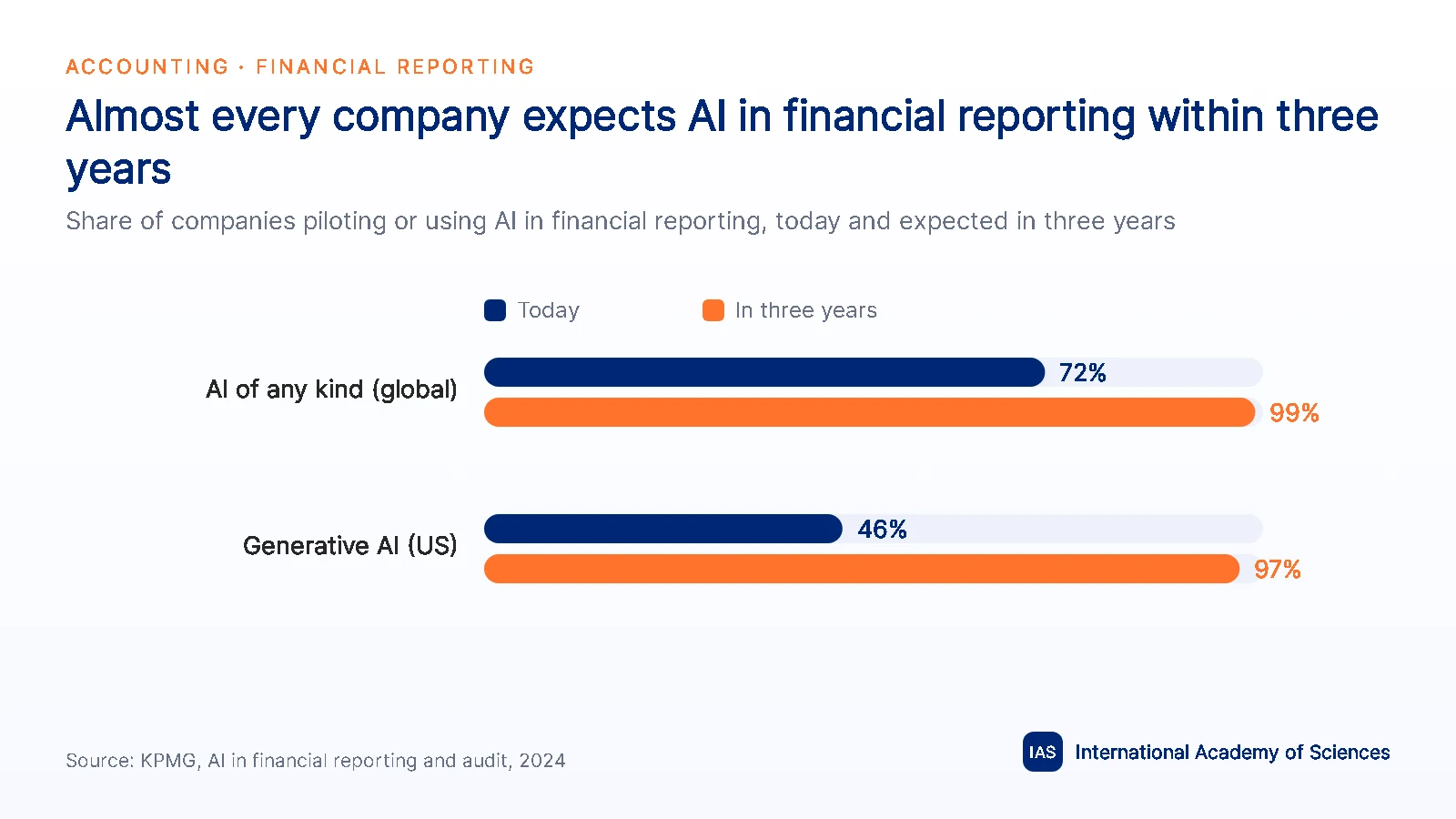
KPMG's global study of 1,800 companies in ten markets, “AI in financial reporting and audit” (2024), gives an even more ambitious picture of expectations. Today 72% of companies pilot or use AI in financial reporting, and 99% expect to do so within three years. In the United States, the share of companies using generative AI in financial reporting is expected to jump from 46% to 97% over the same period. Yet only around one in ten companies reports wide, mature adoption.
Where AI already works in accounting
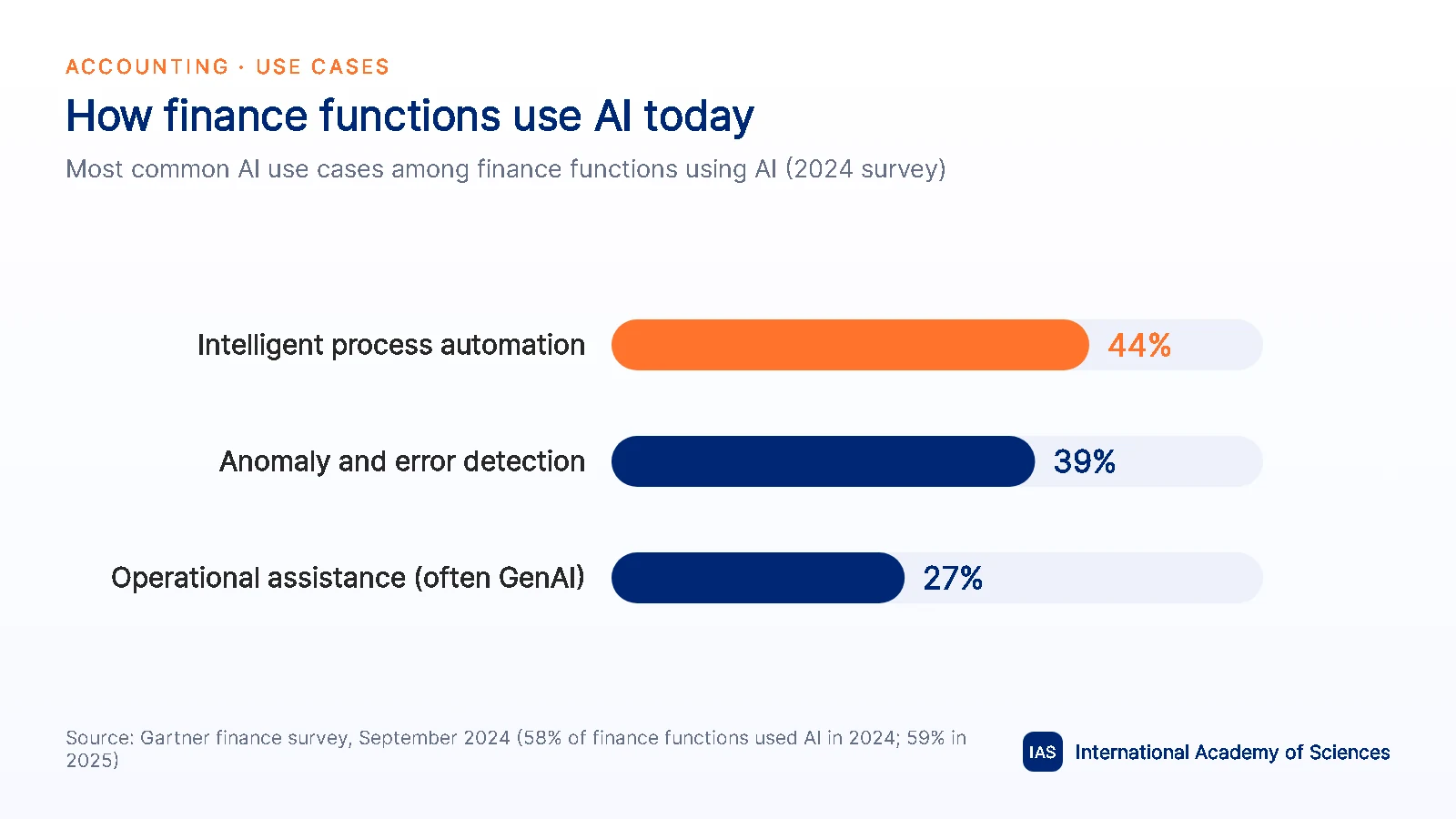
Gartner's data shows the three most common uses of AI in finance: intelligent process automation (44% of AI-using finance functions), anomaly and error detection (39%) and operational assistance, often powered by generative AI (27%). In daily accounting work, this translates into a handful of very concrete use cases:
- Bank and account reconciliations. Models learn matching patterns — batch IDs, partial payments, recurring fees — and clear the bulk of items automatically, leaving accountants to investigate real exceptions.
- Accounts payable. Invoice capture, coding suggestions, three-way matching and duplicate-payment detection.
- Journal-entry review. Anomaly detection highlights entries posted at unusual times, by unusual users or to unusual account combinations.
- Variance analysis and commentary. Generative AI drafts the explanation of why actuals differ from budget, citing the underlying transactions.
- Disclosure and policy questions. Assistants search accounting manuals and standards and suggest where a judgement may be needed.
Real tools on the market
Large software vendors have moved quickly. Microsoft introduced Copilot for Finance in February 2024; it connects to Dynamics 365, Business Central and SAP, and by late 2025 its reconciliation capability was generally available, with variance analysis and data preparation in Excel in preview. In September 2025 BlackLine, a widely used financial close platform, launched Verity — according to the company, a coordinated team of AI agents that detect risks and explain variances across the record-to-report and invoice-to-cash processes. Most ERP and close-management vendors now offer similar assistants.
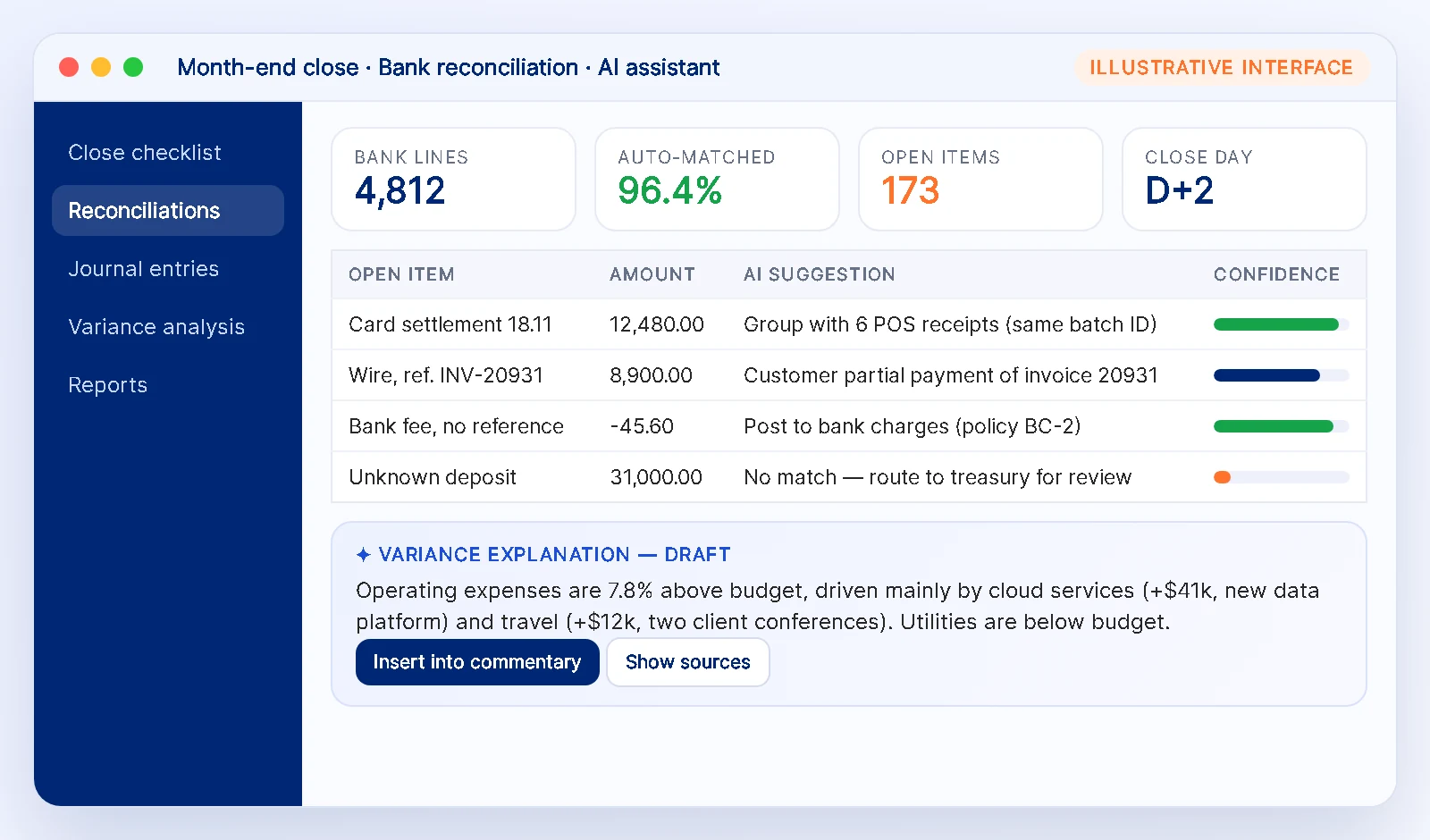
The illustration shows a typical pattern: the machine handles the high-confidence majority, and people focus on what really needs judgement. For finance teams, the result is not fewer accountants but a different job — fewer hours on matching, more time on analysis, controls and business partnering.
What holds AI back
If almost everyone expects AI, why is mature adoption still rare? KPMG's US data is revealing. The most-cited barrier is data security and privacy (56% of companies, up from 32% a year earlier), followed by lack of skills (46%), the difficulty of gathering data (44%) and funding (43%).
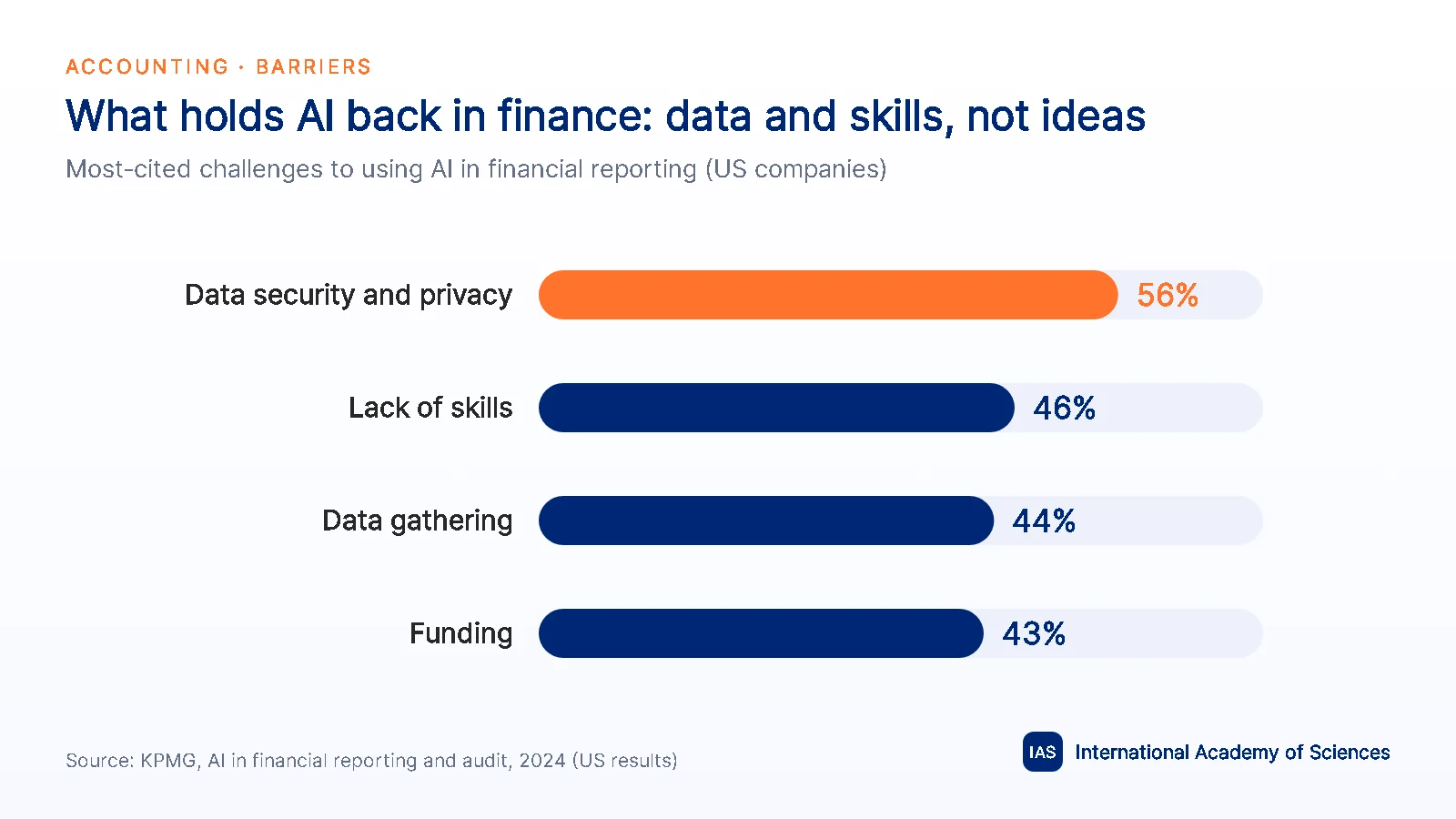
Skills deserve special attention. In a 2026 ACCA study of 1,600 finance professionals, 72% described their generative AI skills as basic or non-existent, and 93% were concerned about whether AI-generated insights can be verified. At the same time, 85% of accountants surveyed by Chartered Accountants Worldwide and Ipsos in 2025 said they would use AI if given the opportunity. The demand is there; the training is not yet.
Governance and the auditor's view
AI in financial reporting also changes the relationship with auditors. In the KPMG study, 61% of companies expect their external auditors to assess the maturity of their AI governance, and a third expect third-party assurance over their use of AI. In practice, this means accounting teams need to document which models are used in which processes, how outputs are reviewed and how errors would be detected — exactly the kind of internal control thinking accountants already know.
The best AI projects in finance start with a controller's question — “How would I prove this number is right?” — and only then with the technology.
Five steps for accounting teams
- Clean the data foundation: consistent chart of accounts, master data and document references.
- Automate high-volume, rule-based work first: reconciliations, invoice processing, recurring entries.
- Add anomaly detection to controls: review risk-scored entries instead of random samples.
- Use generative AI for drafting, not deciding: commentary, memos and checklists — always reviewed.
- Train the team: data literacy, prompt design and the ability to verify AI outputs.
The Institute of Accounting of the International Academy of Sciences offers training and international certification in financial reporting, compliance and modern accounting technology. Visit the Institute of Accounting section to see current programmes.
Sources
- Gartner, finance AI adoption surveys — press releases of 11 September 2024 and 18 November 2025.
- KPMG, “AI in financial reporting and audit”, 2024 — global results (1,800 companies, 10 markets) and US results.
- Chartered Accountants Worldwide and Ipsos, survey of accountants, April 2025 (as reported by ICAEW).
- ACCA, study of 1,600 finance professionals, July 2026.
- Microsoft, Copilot for Finance announcements (February 2024; October 2025); BlackLine, Verity launch (9 September 2025) — as described by the companies.