English
 Russian
 Turkce
 Arabian
 Chinese
The AI-powered audit: how the large audit networks and regulators are reshaping external audit
Agentic AI, full-population testing and new PCAOB rules — what the audit of the future looks like
Audit firms are rolling out AI agents to hundreds of thousands of auditors, companies expect their auditors to use AI, and regulators are updating the rules. A look at the numbers, the platforms and the professional questions behind the AI-powered audit.
For most of its history, the external audit has been built on sampling: auditors could not look at every transaction, so they tested a selection and drew conclusions about the whole. Artificial intelligence is removing that limitation. When a model can score every journal entry in a ledger of a million lines, the auditor's task shifts from finding a needle in a haystack to deciding which of the needles the machine has found really matter.
- 83% of companies say it is important that their auditor uses AI, up from 61% a year earlier (KPMG, US)
- 95,000+ auditors work on KPMG Clara, which added AI agents in April 2025
- 15 Dec 2025 new PCAOB requirements for technology-assisted analysis apply to fiscal years beginning on or after this date
Clients now expect AI in the audit
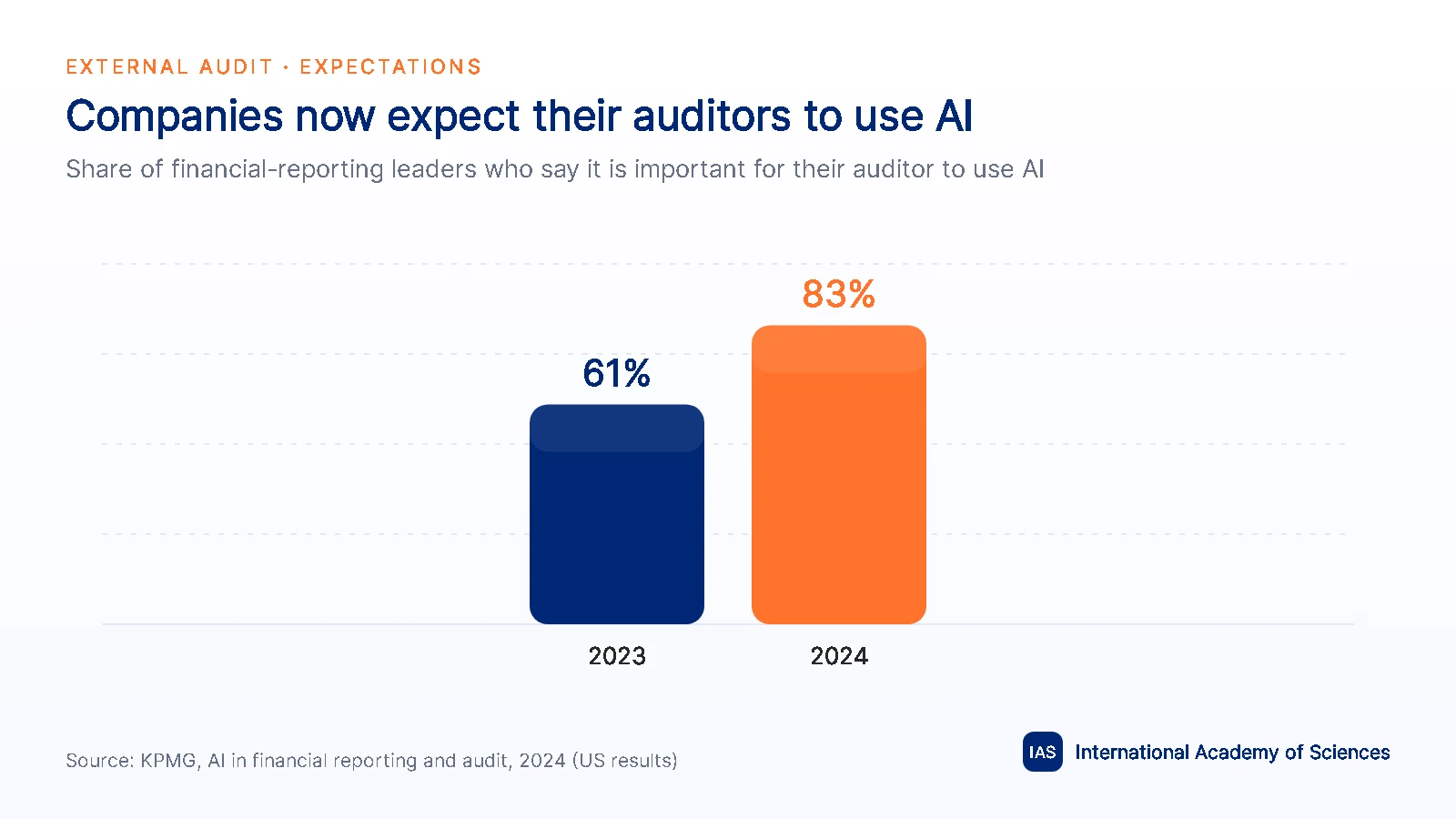
A striking change is coming from the audited companies themselves. In KPMG's 2024 study “AI in financial reporting and audit”, 83% of US financial-reporting leaders said it was important for their auditor to use AI — up from 61% just a year before. Almost three quarters (73%) expect generative AI to become common audit practice within two years.
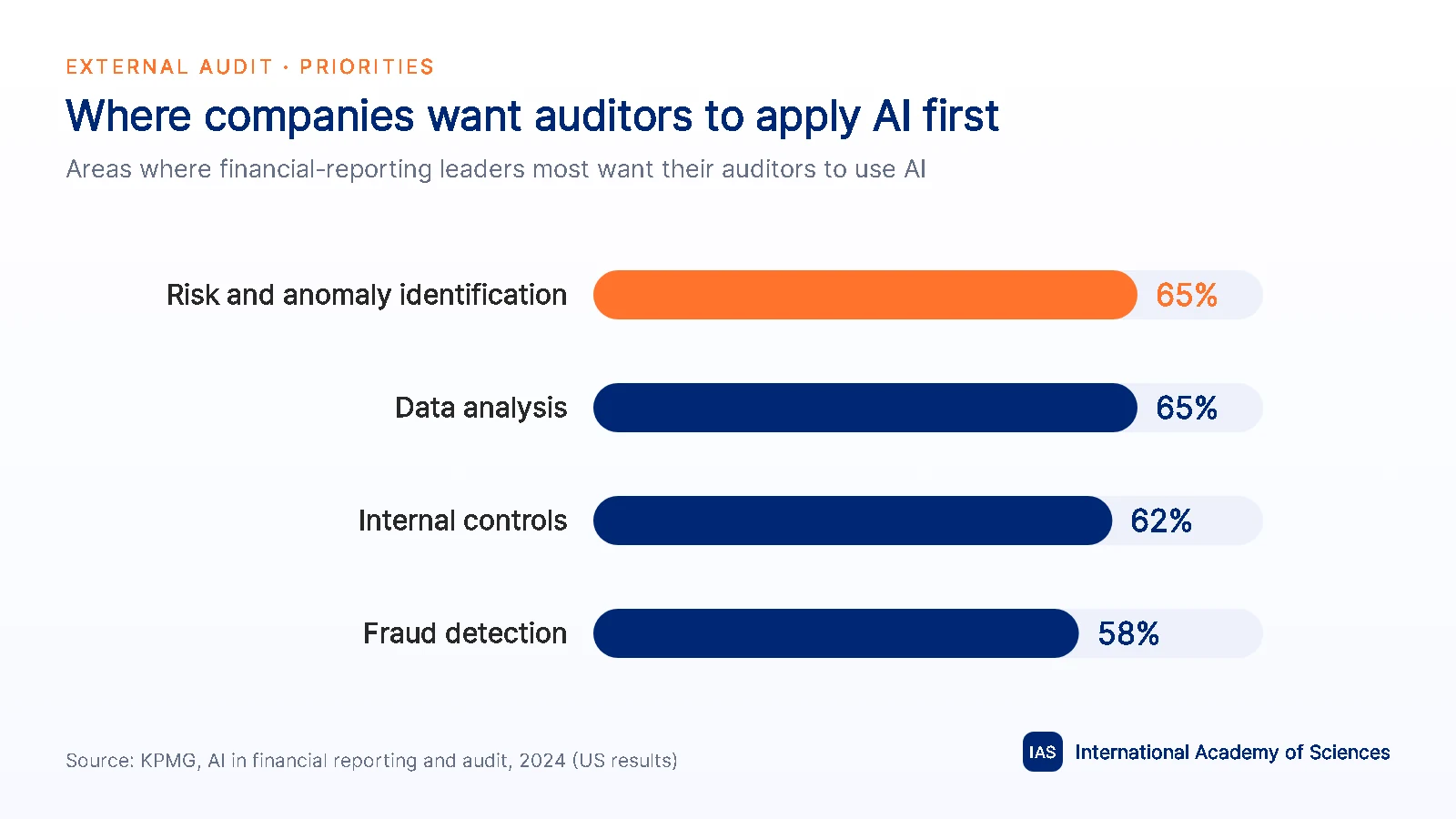
Companies are also clear about where they want AI applied first: risk and anomaly identification (65%), data analysis (65%), internal controls (62%) and fraud detection (58%). In other words, they want the auditor's AI to see more of their data and to see it more intelligently — not just to produce documents faster.
The platforms: from analytics to AI agents
The large audit networks have responded with some of the biggest enterprise AI deployments in any profession:
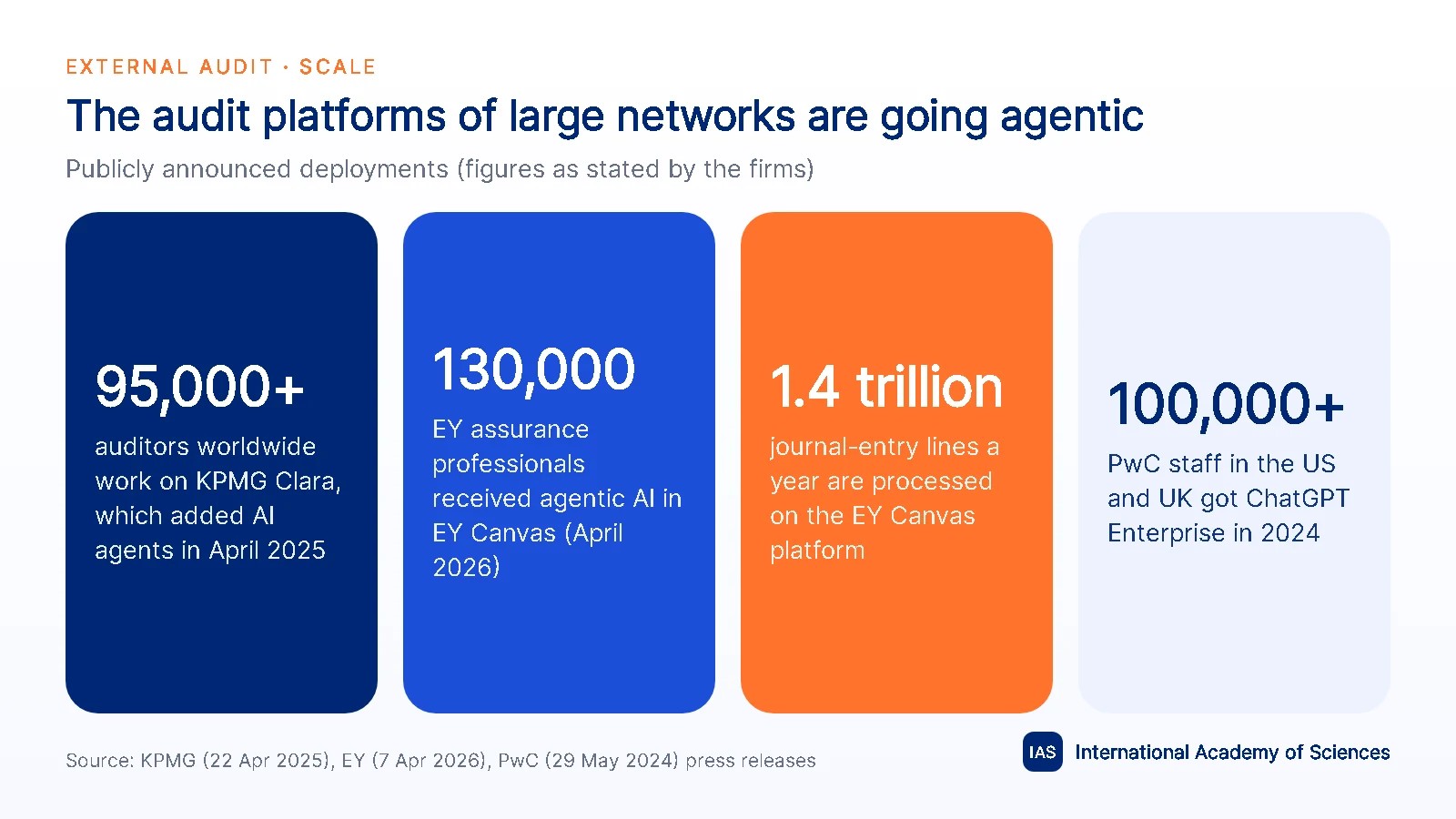
- KPMG Clara. In April 2025 KPMG announced AI agents in its smart audit platform, used by more than 95,000 auditors worldwide. According to the firm, agents support tasks such as expense vouching, the search for unrecorded liabilities and the review of accrued expenses, while a financial report analyser helps complete disclosure checklists.
- EY Canvas. In April 2026 EY announced agentic AI in its global audit platform for about 130,000 assurance professionals across more than 160,000 engagements in over 150 countries. EY states that the platform processes more than 1.4 trillion journal-entry lines a year and aims to cover all end-to-end audit activities by 2028.
- PwC. In May 2024 PwC became one of the largest enterprise users of ChatGPT Enterprise, rolling it out to more than 100,000 staff in the US and the UK as part of a multi-year investment in AI.
- Deloitte. In 2026 Deloitte reported rolling out autonomous AI agents to its auditors worldwide, for example to scan media for emerging risks, sift transactions and documents and draft first versions of memos.
Full-population testing in practice
The most tangible change is in journal-entry testing, one of the key procedures for addressing the risk of management override of controls. Instead of filtering entries with a few fixed criteria, a model scores every entry against dozens of risk drivers — time of posting, user, round amounts, unusual account pairs, reversals after period end — and the engagement team decides which entries to test and why.
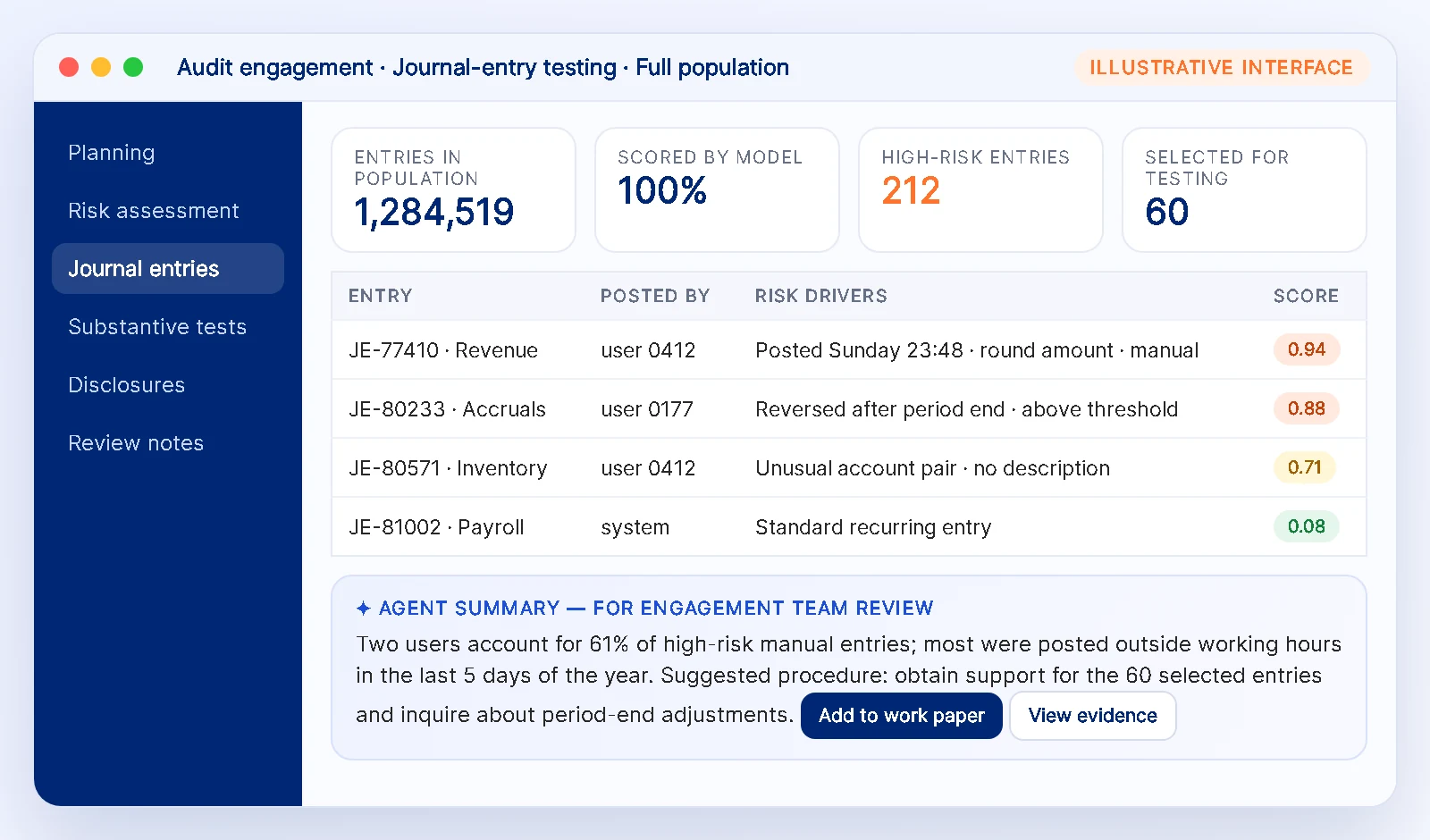
This changes audit evidence in two ways. First, coverage: the auditor can state that the whole population was analysed. Second, focus: the selection of items to test is driven by risk rather than by chance. But it also raises new questions — how reliable is the data extracted from the client's system, how was the model validated and how does the auditor document the reasoning behind the selection?
Regulators are catching up
The US Public Company Accounting Oversight Board (PCAOB) has addressed both sides of the issue. In July 2024 its staff published a Spotlight on generative AI, observing that firms mainly use GenAI for administrative tasks, drafting memos and researching internal guidance, that they limit its use because of privacy and reliability concerns and that human review remains essential. In June 2024 the PCAOB also adopted amendments to its standards AS 1105 and AS 2301 to clarify auditors' responsibilities when they use technology-assisted analysis. The amendments apply to audits of fiscal years beginning on or after 15 December 2025 — so the first audits under the new rules are under way now.
At the same time, audit committees are paying more attention to AI governance at the companies they oversee. The Center for Audit Quality's partner surveys identify AI governance as one of the leading challenges for audit committees, and 61% of companies in the KPMG study expect their auditors to assess the maturity of their AI governance.
Technology can test every transaction, but only an auditor can sign an opinion. The profession's challenge is to let AI widen the evidence while keeping professional scepticism and accountability exactly where they are.
What this means for auditors' skills
- Data skills: understanding data extraction, completeness and integrity checks before any analysis.
- Model literacy: knowing what a risk score means, its limits and how to challenge it.
- Documentation: recording prompts, parameters and the auditor's own judgement so reviewers and inspectors can follow the work.
- Ethics and independence: using client data only in approved, secure environments.
The Institute of Audit of the International Academy of Sciences offers professional training and international certification in audit methodology, including data analytics and the audit of information systems. See the Institute of Audit section for programmes and qualification requirements.
Sources
- KPMG, “AI in financial reporting and audit”, 2024 — US results.
- KPMG International, press release on AI agents in KPMG Clara, 22 April 2025.
- EY, press release on agentic AI in EY Canvas, 7 April 2026.
- PwC, press release on ChatGPT Enterprise rollout, 29 May 2024.
- Deloitte AI audit rollout as reported by Bloomberg Law, June 2026.
- PCAOB, Staff Spotlight on generative AI, July 2024; amendments to AS 1105 and AS 2301 adopted 12 June 2024.
- Center for Audit Quality, Audit Partner Pulse surveys.