English
 Russian
 Turkce
 Arabian
 Chinese
AI in HR: recruiting, people analytics and the new rules of fair hiring
HR adopted AI faster than almost any other function — now it has to prove value and fairness
The share of organisations using AI in HR jumped from 26% to 43% in a year, with recruiting leading the way. But most HR leaders have not yet seen significant business value, and regulators treat hiring algorithms as high-risk. Here is the full picture.
Human resources is where artificial intelligence meets people most directly — and where its mistakes are most personal. A model that writes a better job description saves time; a model that wrongly screens out a qualified candidate can cost someone a career and an employer a lawsuit. That is why the story of AI in HR is about two things at once: remarkable speed of adoption and a growing focus on fairness, transparency and accountability.
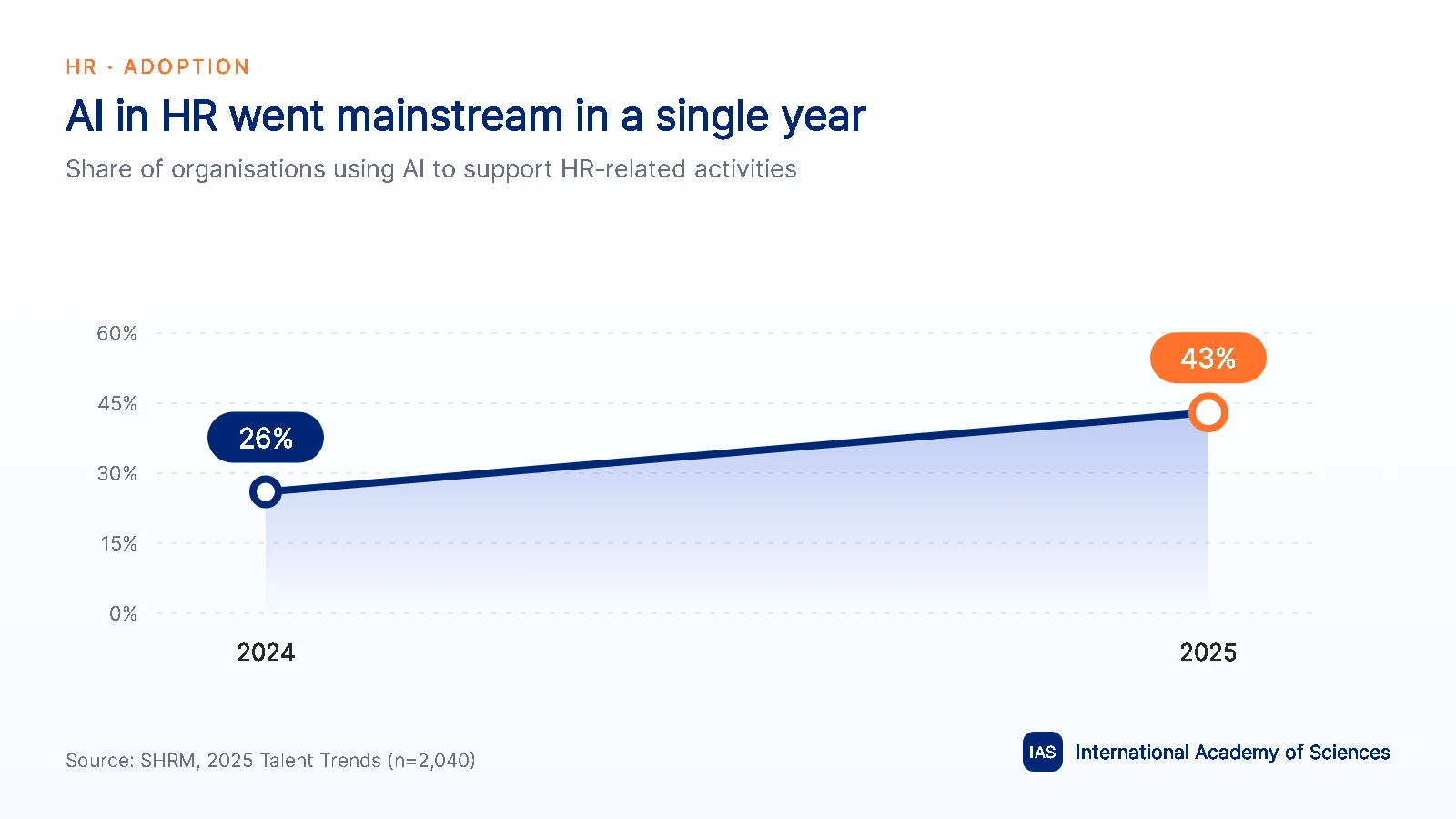
- 43% of organisations use AI to support HR activities, up from 26% a year earlier (SHRM, 2025)
- 51% of organisations using AI in HR apply it to recruiting — the most common use (SHRM)
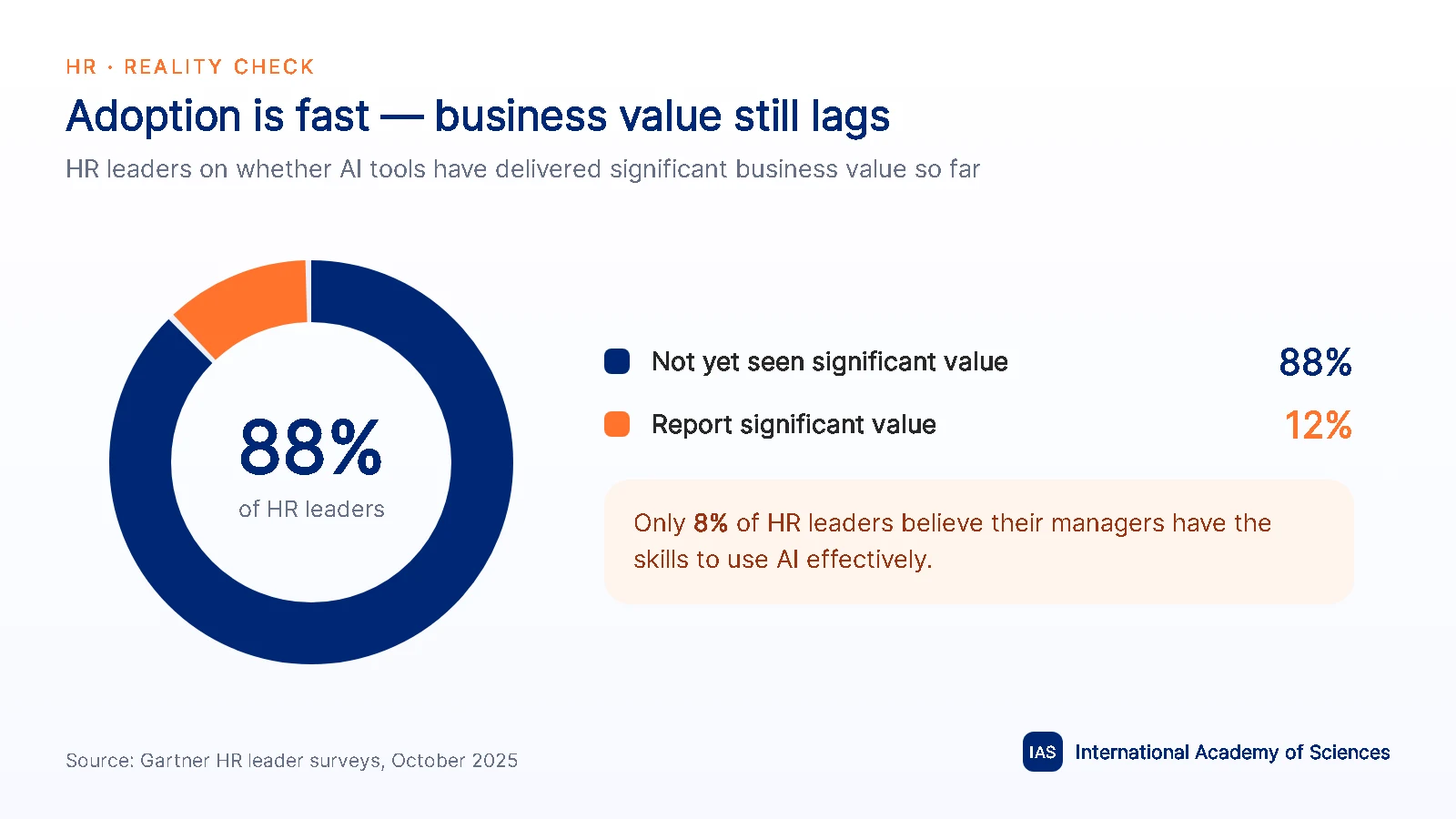
- 88% of HR leaders say AI has not yet delivered significant business value (Gartner, 2025)
From pilot to mainstream in a year
The Society for Human Resource Management (SHRM) tracks AI use in HR in its annual Talent Trends research. In its 2025 survey of 2,040 HR professionals, 43% of organisations reported using AI to support HR-related activities — up from 26% in 2024. Gartner's surveys of HR leaders show a similar curve for generative AI: the share of HR functions piloting or implementing GenAI doubled from 19% in mid-2023 to 38% in early 2024.
Recruiting leads the way
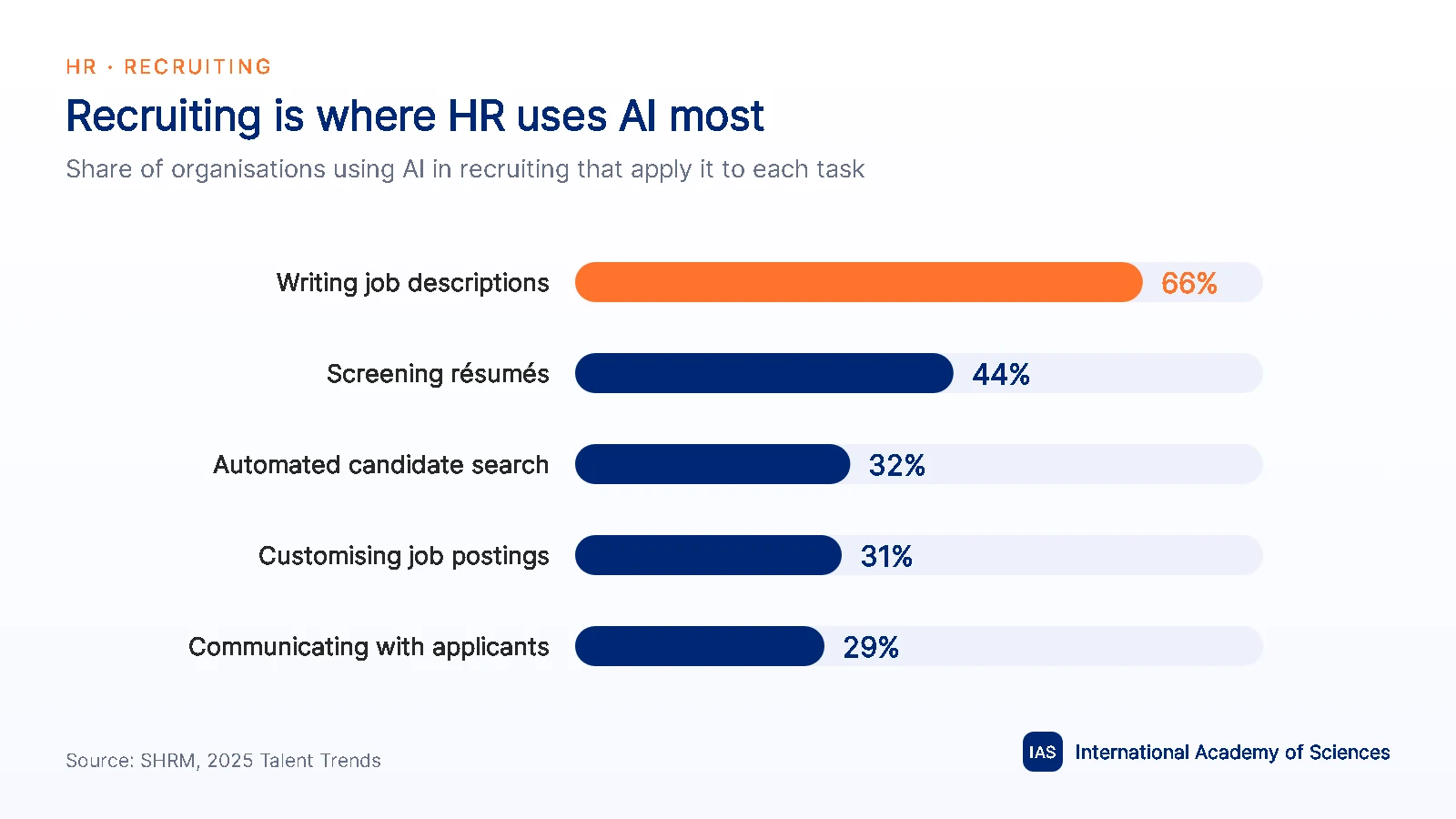
Recruiting is by far the most common area: 51% of organisations that use AI in HR apply it to recruiting. Inside recruiting, SHRM's data shows a clear order of use cases. Writing job descriptions comes first (66%), followed by screening résumés (44%), automated candidate search (32%), customising job postings (31%) and communicating with applicants (29%).
The market has followed. LinkedIn launched Hiring Assistant, its first AI agent for recruiters, in late 2024 and made it available globally in English by September 2025; it supports sourcing and screening. One of the most cited early examples is Unilever, which several years ago combined online assessments with AI-assessed video interviews for its graduate programme; the company reported saving around 100,000 hours of interviewing time a year. Beyond recruiting, AI is used in onboarding chatbots, learning recommendations, internal mobility (matching employees with open roles based on skills) and people analytics such as attrition risk.
What responsible AI screening looks like
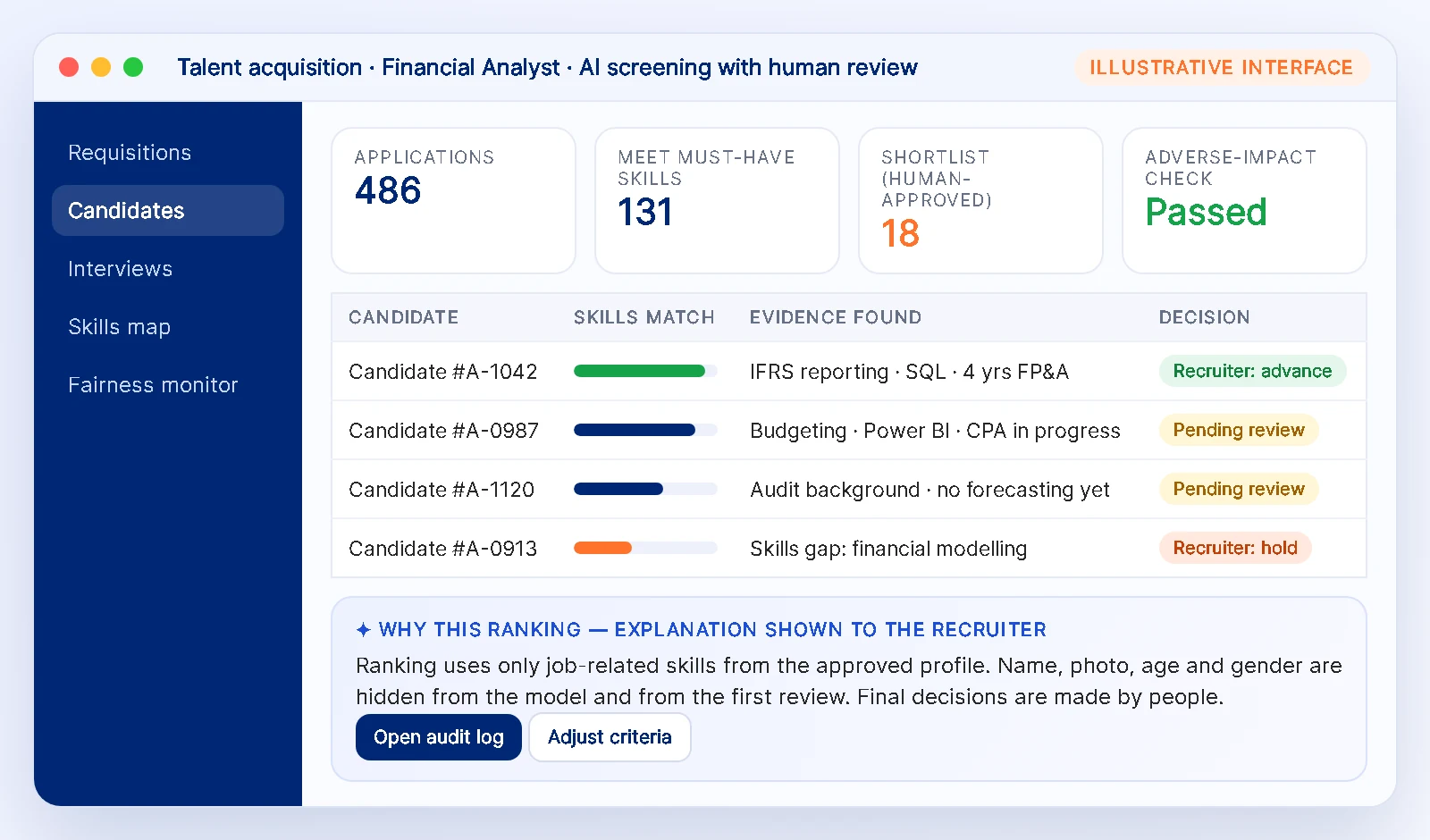
The illustration shows the principles that well-designed systems follow: transparent, job-related criteria; explanations a recruiter can understand; people making the final decisions; a full audit log; and regular checks for adverse impact on protected groups. None of these are optional extras — they are what separates a useful tool from a legal and reputational risk.
The value gap
Despite fast adoption, results are not automatic. In an October 2025 Gartner survey, 88% of HR leaders said their organisations had not yet realised significant business value from AI tools. Gartner also found that only 8% of HR leaders believe their managers have the skills to use AI effectively.
The pattern is familiar from other functions: tools are introduced into old processes, while the work itself — how vacancies are defined, how interviews are structured, how performance is discussed — stays the same. Value appears when HR redesigns the process around the tool and trains managers to use it.
Regulation and litigation
Hiring is one of the most regulated uses of AI. Under the European Union's AI Act, AI systems used for recruitment, selection and decisions about employment are classified as high-risk (Annex III). This brings obligations on risk management, data quality, human oversight, transparency to candidates and record keeping. The application timeline for high-risk obligations was revised in 2026, so employers operating in the EU should check the current deadlines — but the direction is clear.
Courts are also testing the issue. In May 2025 a US federal court allowed the case Mobley v. Workday to proceed as a collective action on age-discrimination claims, based on allegations that AI tools used to score, sort and screen applicants disadvantaged candidates over forty. Whatever the final outcome, the case shows that both employers and technology providers can be drawn into disputes about algorithmic hiring.
In HR, AI should widen the funnel of good candidates, not narrow it by hidden criteria. If a decision cannot be explained to the person it affects, it should not be made by a model.
A checklist for HR teams
- Define job-related criteria first and make sure the tool uses only those.
- Keep people in charge of every hiring, promotion and dismissal decision.
- Test for adverse impact before launch and regularly afterwards.
- Tell candidates and employees when and how AI is used.
- Ask vendors hard questions about training data, validation and audit rights.
- Train managers — the skills gap is the biggest brake on value.
The Human Resource Institute of the International Academy of Sciences offers training and international certification for HR professionals, covering modern talent management, HR analytics and the responsible use of technology. Visit the Human Resource Institute section for programmes and qualifications.
Sources
- SHRM, 2025 Talent Trends: AI in HR (n=2,040, fielded February 2025).
- Gartner, HR leader surveys — press releases of 27 February 2024 and 28 October 2025.
- LinkedIn, Hiring Assistant announcements (October 2024; September 2025).
- Unilever graduate recruitment case, as reported in the press (company estimate of time saved).
- Regulation (EU) 2024/1689 (AI Act), Annex III; subsequent 2026 amendments to the application timeline.
- Mobley v. Workday, Inc., US District Court for the Northern District of California, order of 16 May 2025.