English
 Russian
 Turkce
 Arabian
 Chinese
Internal audit meets AI: how audit functions are putting generative AI to work
From risk assessment to full-population testing — what is changing, and what auditors must still own
Generative AI use in internal audit has more than doubled in a year. We look at where audit teams actually apply it, which tools are reaching the market and why governance, not technology, is now the main challenge for chief audit executives.
For years, data analytics in internal audit was the domain of a few specialists. Generative AI has changed that almost overnight: today an auditor can ask a model to draft a risk and control matrix, summarise hundreds of policy pages or suggest test steps in plain language. The question for chief audit executives is no longer whether to use AI, but how to use it without weakening the independence and evidence standards that make internal audit valuable.
- 40% of internal audit functions now use GenAI in audit work, up from 15% a year earlier (The IIA)
- 41% of internal audit teams said in 2024 that they used or planned to use GenAI that year (Gartner)
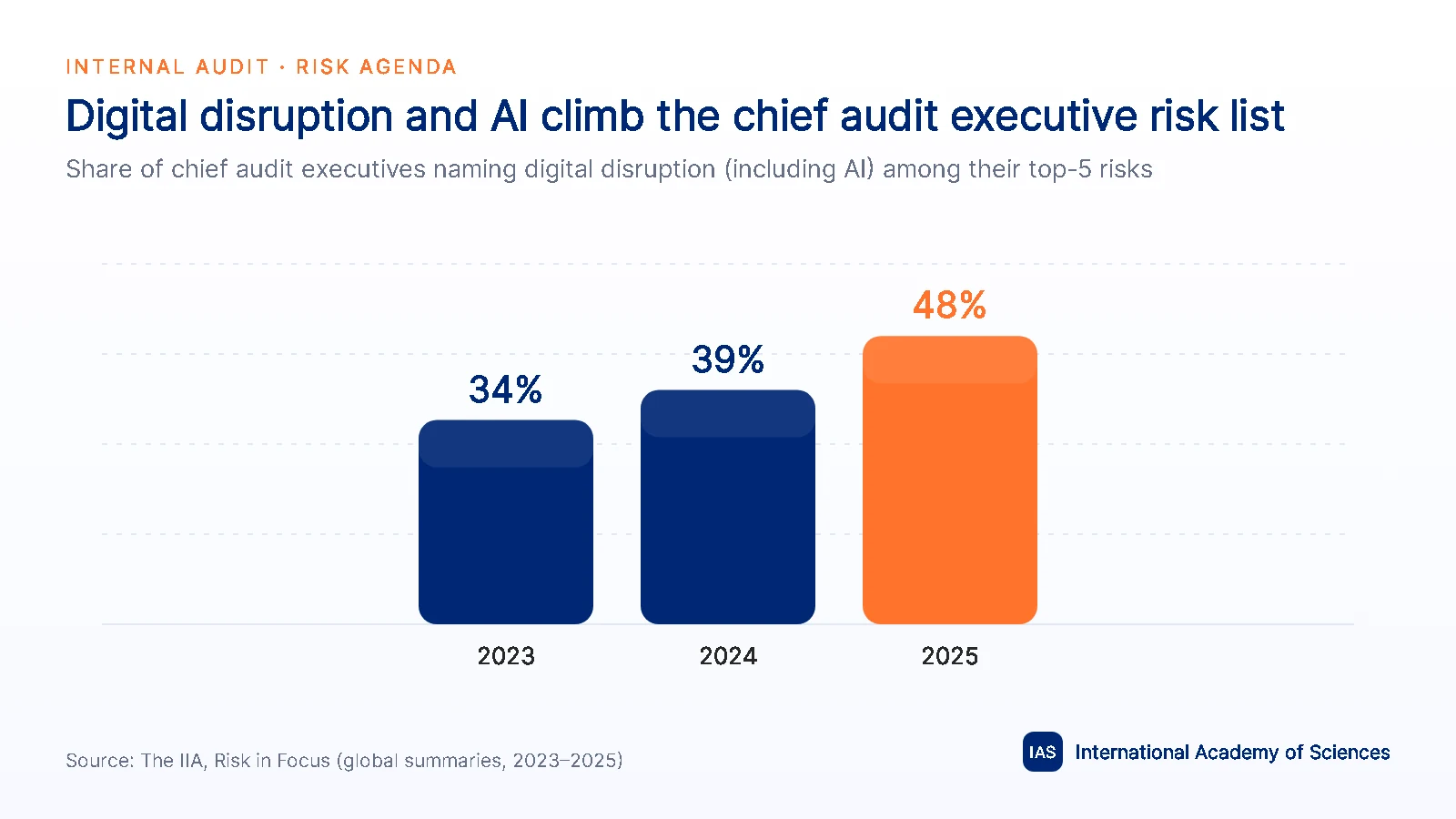
- 48% of chief audit executives named digital disruption, including AI, a top-5 risk in 2025 (The IIA, Risk in Focus)
Adoption: from experiment to everyday tool
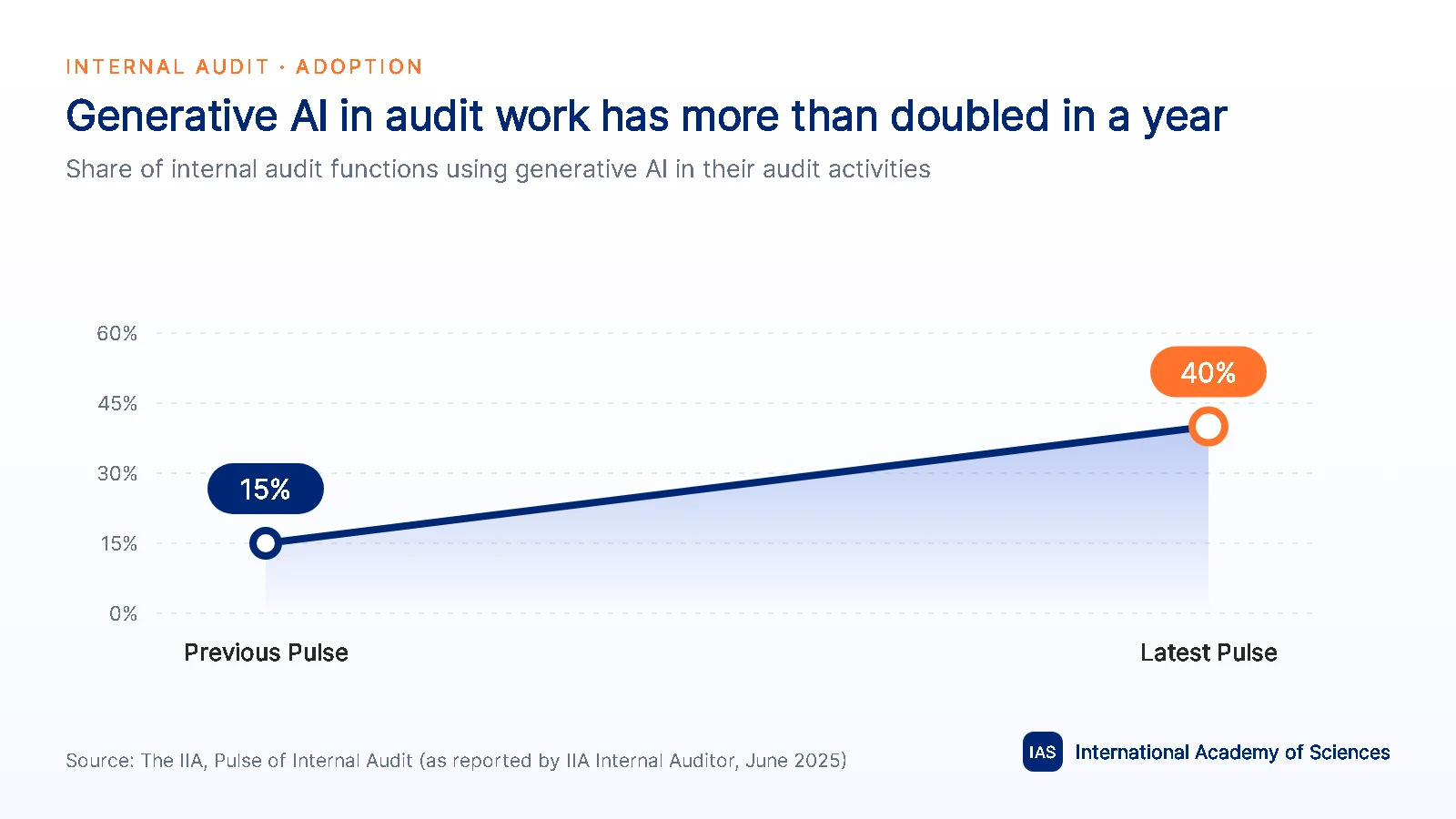
The clearest signal comes from The Institute of Internal Auditors. According to its latest Pulse of Internal Audit, the share of audit functions using generative AI in their audit activities rose from 15% to 40% in a single year. A large Wolters Kluwer survey of more than four thousand internal auditors, published in May 2025, points in the same direction: 39% said they already use AI and another 41% planned to adopt it within twelve months.
Adoption, however, is still shallow. Most teams are at the stage of individual experimentation rather than formal, governed programmes. In a Wolters Kluwer TeamMate poll from October 2026, 43.8% of respondents described their AI use as individual experimentation, 22.4% as approved departmental use cases and only 17.7% as a formal programme or broad adoption. The poll is not representative, but the pattern matches what we see in practice: enthusiasm is high, standardisation is low.
Where in the audit cycle AI is really used
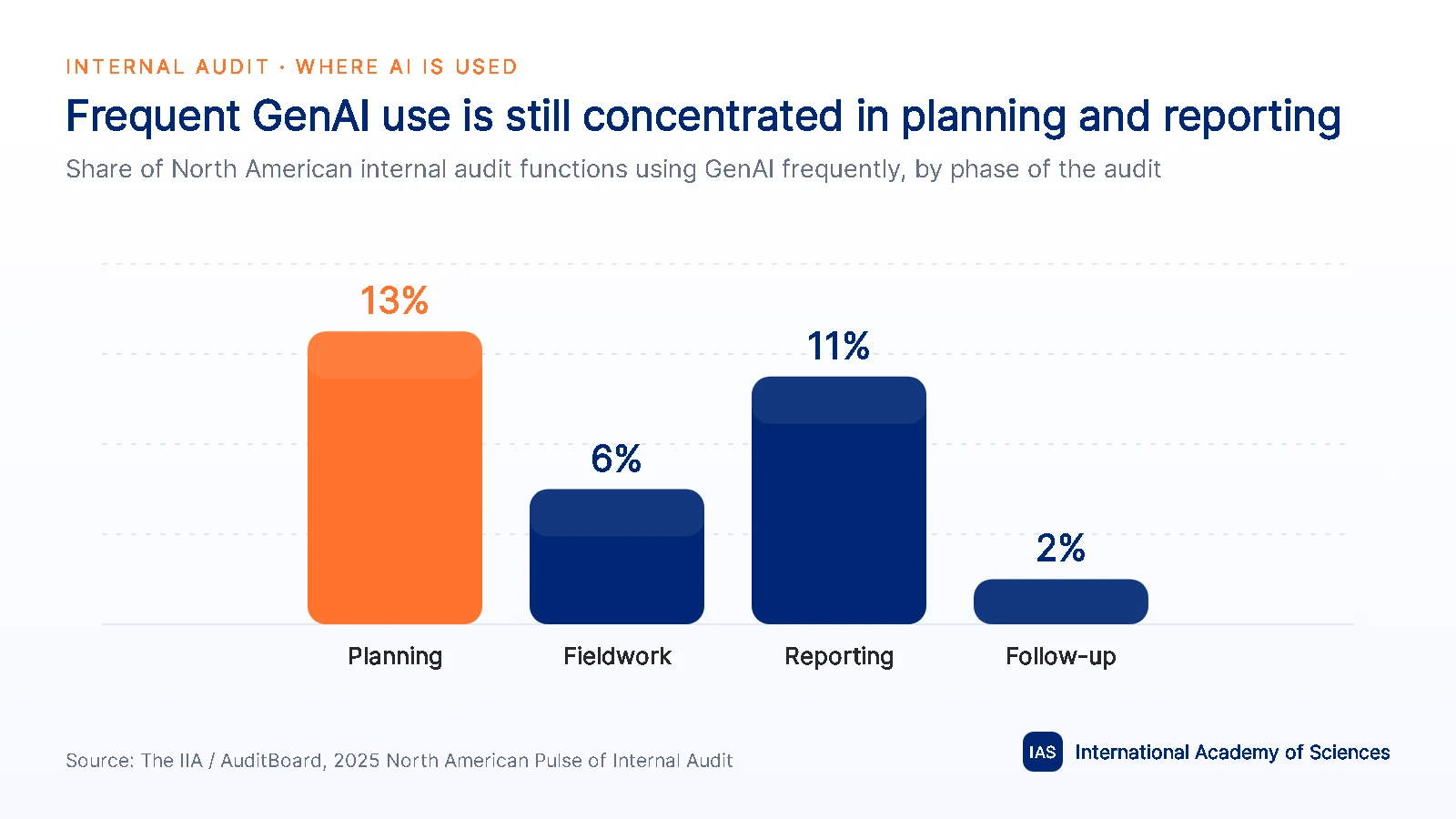
The IIA and AuditBoard 2025 North American Pulse breaks usage down by audit phase. Frequent use of GenAI is highest in planning (13%) and reporting (11%), much lower in fieldwork (6%) and almost absent in follow-up (2%). The reason is simple: planning and reporting are language-heavy tasks — scoping memos, risk descriptions, audit programmes, report drafts — exactly where large language models are strongest. Fieldwork depends on access to client data, evidence handling and professional judgement, so teams are more cautious there.
Typical, already proven applications include:
- Risk assessment and planning — summarising board minutes, prior reports, regulatory changes and policies to build a first draft of the audit universe and risk ratings.
- Risk and control matrices — generating draft process descriptions, control lists and test steps that the auditor then reviews and adapts.
- Full-population testing — classic machine-learning and rule-based analytics applied to 100% of transactions (duplicate payments, vendor master changes, segregation of duties) instead of small samples.
- Reporting — turning work papers into a clear draft report, consistent ratings and an executive summary.
What an AI-assisted audit workspace looks like
Audit software vendors are embedding these capabilities directly into their platforms. In March 2025 AuditBoard launched a set of AI features for internal audit, SOX and controls testing, later adding natural-language workflows. In August 2026 Deloitte announced ControlCatalyst.AI, which, according to the firm, generates process flows, risk and control matrices and test steps for internal audit teams. The illustration below shows the general pattern such tools follow.
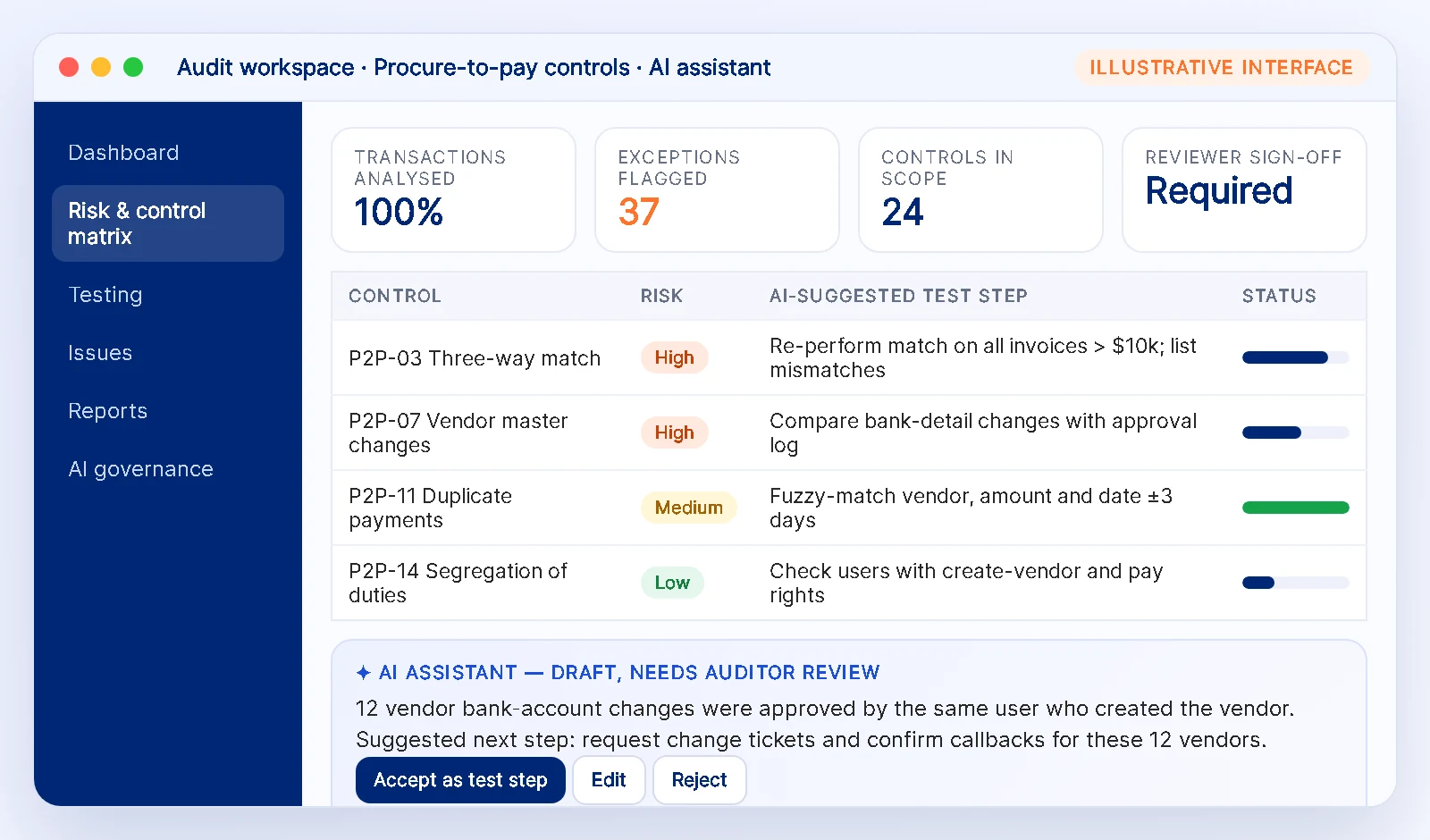
Note the design principle in the example: the AI analyses the full population and proposes next steps, but the auditor signs off. This “human in the loop” approach is not a formality. Under the Global Internal Audit Standards, effective from 9 January 2025, conclusions must rest on sufficient, reliable and relevant evidence and on the auditor's professional judgement — a model's output is an input to that judgement, never a substitute for it.
AI is also a new audit subject
Internal audit faces AI from two sides. It uses AI as a tool, and it must also give assurance over how the rest of the organisation uses AI. The IIA's Risk in Focus research shows how quickly this topic has moved up the agenda: the share of chief audit executives who rank digital disruption, including AI, among their top five risks grew from 34% in 2023 to 39% in 2024 and 48% in 2025, making it the second-highest global risk after cybersecurity.
To audit AI, many functions use The IIA's AI Auditing Framework, updated in 2024 and built around the Three Lines Model. Typical audit questions include: Is there an inventory of AI systems in use? Who approved each use case, and on what risk assessment? How are training data, prompts and outputs protected? How is model performance monitored, and who can switch a model off?
Risks auditors must manage
- Confidentiality. Client and company data must not leave approved environments. Public chatbots are not an acceptable place for audit evidence.
- Accuracy and “hallucinations”. Language models can produce confident but wrong statements. Every AI output used in a work paper needs to be traced to source evidence.
- Documentation. Reviewers must be able to see which parts of the work were AI-assisted, which prompts and data were used and what the auditor changed.
- Skills. In the Wolters Kluwer survey, 84% of respondents said AI skills already matter when hiring internal auditors. Data literacy, prompt design and the ability to challenge a model are becoming core competencies.
AI does not replace the auditor's scepticism — it gives that scepticism more data to work with. The functions that gain most are those that pair new tools with clear rules on evidence, review and confidentiality.
A practical roadmap for an internal audit function
- Set the rules first. Approve an acceptable-use policy for AI in audit work: permitted tools, data that may and may not be used, documentation and review requirements.
- Start with language-heavy tasks. Planning memos, risk libraries and report drafting give quick wins with low risk.
- Move analytics to the full population. Combine rule-based tests with machine-learning anomaly detection on complete data sets.
- Build an AI assurance plan. Add AI governance, model risk and third-party AI to the risk-based audit plan.
- Invest in people. Train auditors to use AI critically — and to document what they did.
The Institute of Audit of the International Academy of Sciences offers professional training and international certification for internal auditors, including modern audit methodology, data analytics and governance of new technologies. Explore our programmes and qualifications in the Institute of Audit section.
Sources
- The IIA, Pulse of Internal Audit — as reported in “Voice of the CEO: AI and internal audit — 5 global trends”, Internal Auditor, June 2025.
- The IIA and AuditBoard, 2025 North American Pulse of Internal Audit.
- Gartner, survey of internal audit leaders, press release of 11 March 2024.
- Wolters Kluwer, survey of 4,214 internal auditors, May 2025; TeamMate webinar poll, October 2026 (non-representative).
- The IIA, Risk in Focus 2023–2025 global summaries; The IIA AI Auditing Framework (2024 update).
- AuditBoard and Deloitte product announcements (March 2025; 5 August 2026), as described by the companies.