English
 Russian
 Turkce
 Arabian
 Chinese
Bachelor's Degree Programs
Undergraduate studies: a strong academic foundation and a practical start to an international career
A bachelor’s degree is the first cycle of higher education and the foundation of a professional career. Our undergraduate programmes combine solid theory, project-based learning and practice, and prepare you both for employment and for master’s study.
A bachelor’s degree is more than a diploma: it is the stage at which a student learns how a discipline thinks, acquires the core tools of a profession and builds the habits of independent study that will serve for a whole career. The International Academy of Sciences, together with its academic partners, offers bachelor’s programmes in business, economics, management, information technology, law, the social sciences and other fields — in formats suited to both school leavers and working adults.
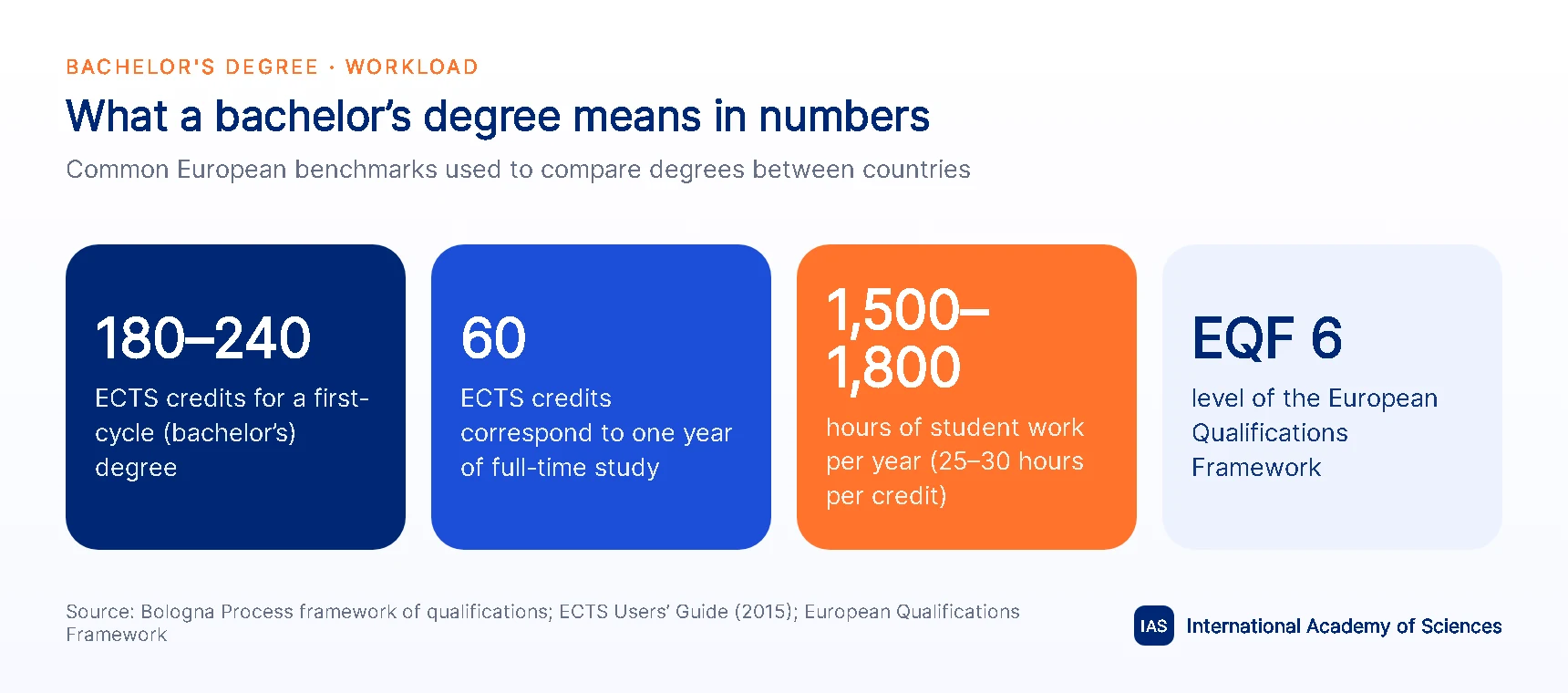
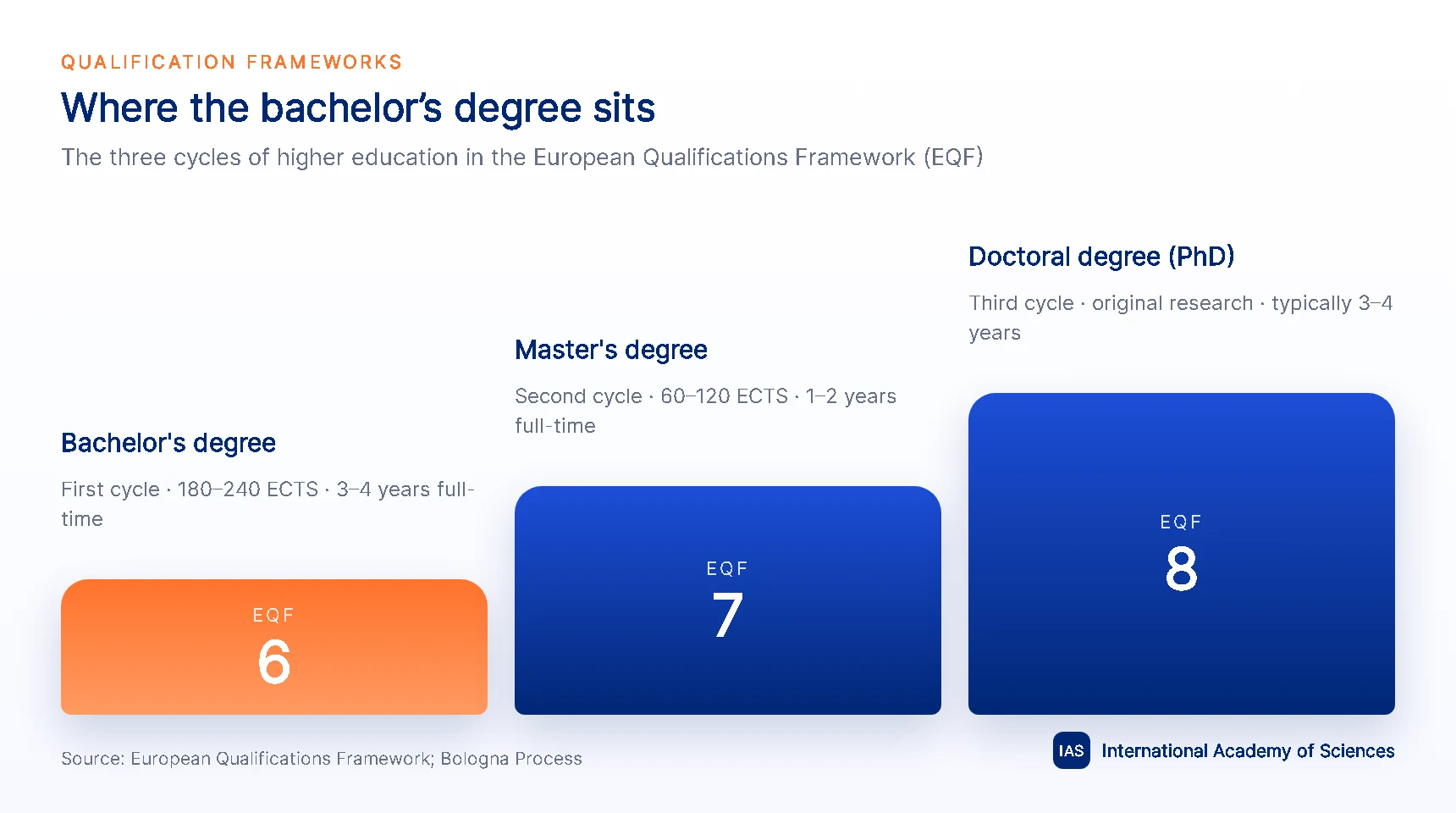
- 180–240 ECTS credits — the standard size of a first-cycle degree in the European Higher Education Area
- 3–4 years of full-time study, with flexible part-time and online formats
- EQF 6 level of the European Qualifications Framework, the reference point for international recognition
What the numbers mean
Across Europe and in many other countries, degrees are described in ECTS credits — the European Credit Transfer and Accumulation System. One academic year of full-time study corresponds to 60 credits, and one credit represents roughly 25–30 hours of student work, including lectures, seminars, projects and independent study. A bachelor’s degree usually requires 180 or 240 credits, that is three or four years of full-time study. These common units make it possible to compare programmes between countries, transfer credits and continue studies abroad.
How the programme is built
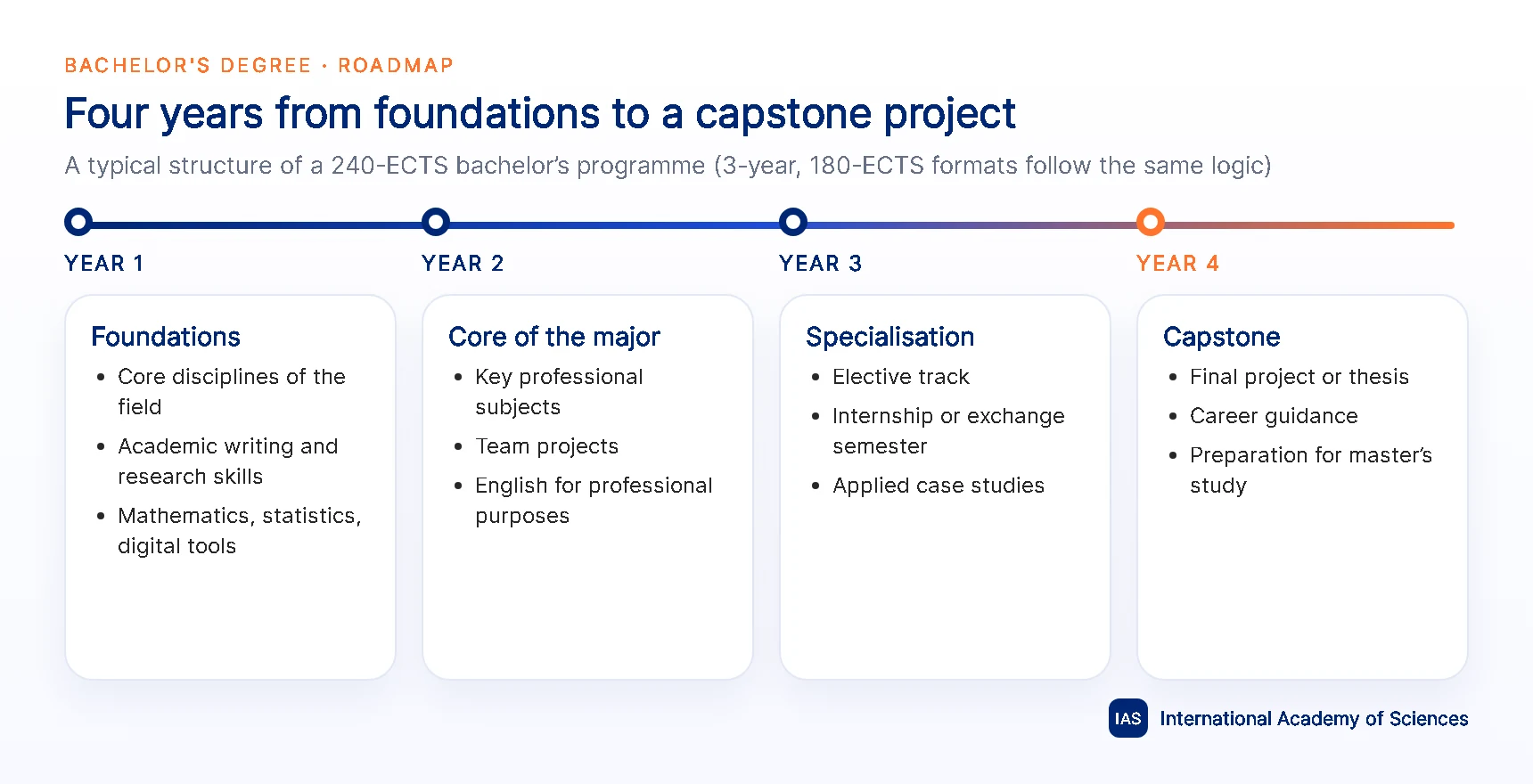
Our bachelor’s programmes follow a clear progression. The first year gives the foundations: the core disciplines of the field, academic writing, research skills, mathematics, statistics and digital tools. The second year forms the core of the major, with key professional subjects, team projects and professional English. In the third year students choose a specialisation and complete an internship or an exchange semester. The fourth year is devoted to a capstone project or thesis, career guidance and preparation for master’s study.
Throughout the programme we use project-based learning: students work on real cases from companies and organisations, present their results and receive feedback from practitioners. This approach develops exactly what employers ask for — critical thinking, the ability to work in a team, to analyse data and to communicate conclusions clearly.
Fields of study
- Business and management — strategy, marketing, operations, entrepreneurship.
- Economics and finance — economic analysis, accounting, financial management, audit.
- Information technology — software, data analysis, digital transformation and artificial intelligence.
- Law and mediation — legal foundations, contract and international law, dispute resolution.
- Social sciences — psychology, sociology, public administration and human resource management.
Study formats
Students can choose full-time study, part-time study combined with work, or online and hybrid formats. Online learning includes live classes, recorded lectures, digital libraries and regular contact with tutors; assessments are organised so that the academic standards are the same in every format. English-medium instruction is available in many fields.
Why study with the Academy
- Degrees awarded in cooperation with recognised academic partners and aligned with international qualification frameworks.
- Access to international exchange programmes and internships through our partner network.
- Project-based learning and modern educational technologies.
- Career guidance and preparation for graduate school.
- Every qualification is entered in the Academy’s registry and can be verified online.
Admission
Applicants need a completed secondary education certificate (or its equivalent) and, for programmes taught in English, evidence of language proficiency. Applicants with previous studies or significant professional experience may have part of their learning recognised, which can shorten the programme. Our managers will help you prepare the documents and choose the right field and format.
After graduation
Graduates start careers in companies, public institutions and international organisations, or continue to a master’s degree. Because the bachelor’s degree corresponds to level 6 of the European Qualifications Framework, it gives access to second-cycle programmes in many countries.
To discuss admission, the choice of field and the documents you need, send a request through the website or contact the Academy’s managers — we will help you choose the programme and format that fit your goals.