English
 Russian
 Turkce
 Arabian
 Chinese
Master's Degree Programs
Graduate education: advanced specialisation, leadership and applied research
A master’s degree gives advanced, specialised knowledge for the modern global economy. It is designed for bachelor’s graduates who want to deepen their expertise, change professional direction or begin an academic career.
A master’s degree is the point at which a professional moves from knowing a field to shaping it. Master’s students study the most recent theory and methods, apply them to real problems and complete an independent research project. The International Academy of Sciences, together with its academic partners, offers master’s programmes that combine academic depth with practical relevance — taught by international faculty and research-active instructors.
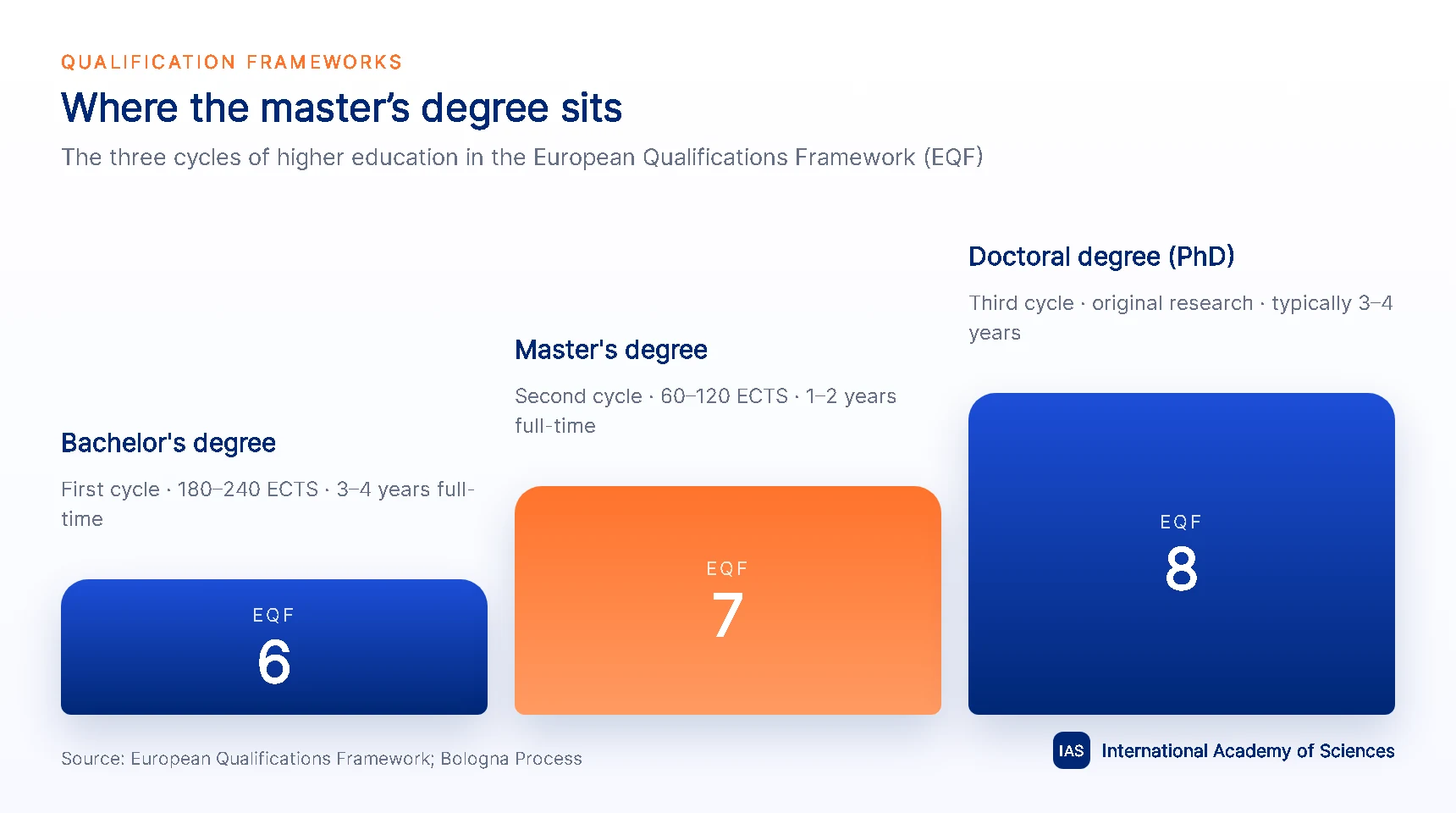
- 60–120 ECTS credits — the standard size of a second-cycle degree
- 1–2 years of full-time study; part-time and online formats for working professionals
- EQF 7 level of the European Qualifications Framework, giving access to doctoral studies
Who the programme is for
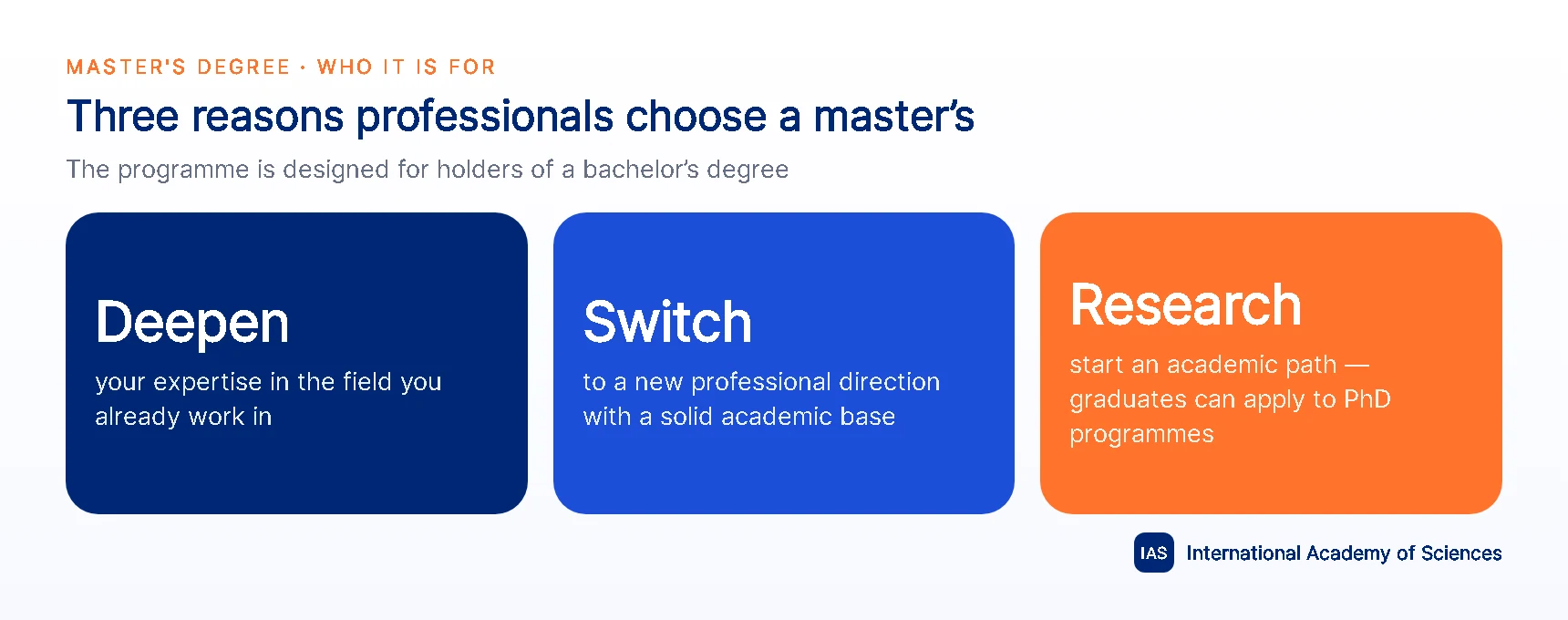
Master’s students come with different goals. Some want to deepen their expertise in the field they already work in and move into senior and expert positions. Others want to change professional direction and need a solid academic base in a new area. A third group plans an academic career and uses the master’s degree as a step towards a PhD. Our programmes are built to serve all three paths.
Structure of the programme
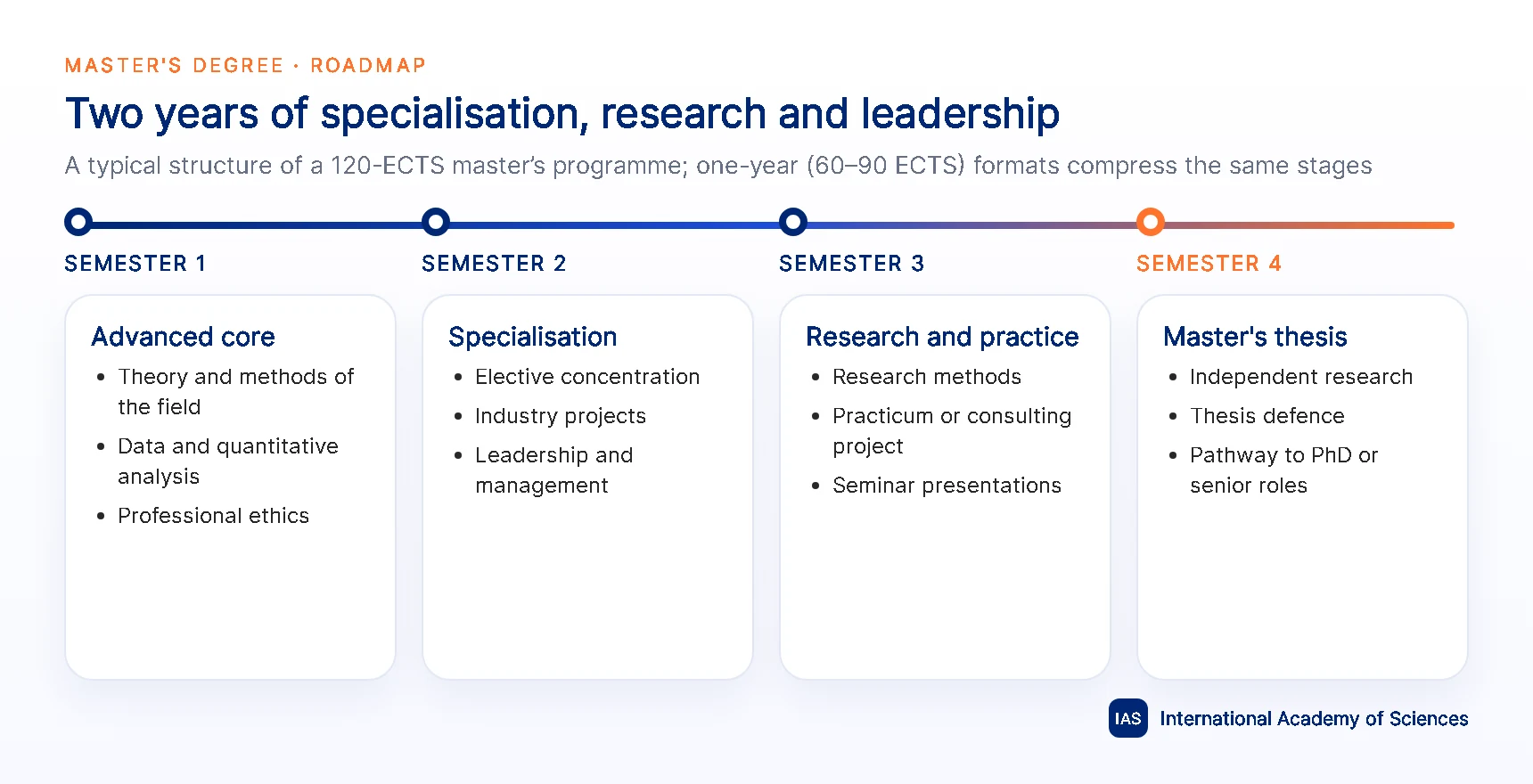
A typical two-year master’s programme of 120 ECTS credits consists of four stages. The first semester covers the advanced core of the discipline: theory and methods, quantitative and data analysis, professional ethics. In the second semester students choose a concentration, work on industry projects and develop leadership and management skills. The third semester focuses on research methods and practice — a practicum or a consulting project for a real organisation. The fourth semester is devoted to the master’s thesis and its defence. One-year programmes of 60–90 credits follow the same logic in a compressed form.
Compared with a bachelor’s degree, the master’s level demands much more independent work. Students read research literature, design their own studies, analyse data and present their findings to experts. This is what develops the analytical and leadership capabilities that employers value at senior levels.
Areas of specialisation
- Management and leadership — strategic management, project management, management in education.
- Finance, accounting and audit — financial reporting, internal and external audit, risk management.
- Law and mediation — international law, dispute resolution and negotiation.
- Human resources and psychology — talent management, organisational psychology, HR analytics.
- Digital technologies and AI — data analysis, digital transformation, governance of artificial intelligence.
Learning formats
Programmes are available on campus, in a hybrid format and fully online. Online students attend live seminars, work in project teams, use digital libraries and have regular consultations with their supervisor. The academic requirements, assessments and thesis standards are the same in all formats.
The master’s thesis
The thesis is the centre of the programme. Under the guidance of a supervisor, the student formulates a research question relevant to science or practice, reviews the literature, chooses methods, collects and analyses data and writes up the results. The thesis is defended before a committee. Many of our students choose topics from their own organisations, so the research brings immediate practical value.
Why choose the Academy
- International faculty and research-active instructors.
- Flexible formats: on campus, hybrid and fully online.
- Emphasis on innovation, leadership and global issues.
- Integration of academic theory with industry practice.
- Graduates are eligible to apply directly to our PhD programmes.
Admission
Applicants need a bachelor’s degree or an equivalent higher-education qualification. Depending on the programme, we may also consider professional experience, a motivation letter and an interview; for English-taught programmes, evidence of language proficiency is required. Our managers will help you assess your documents and choose the specialisation.
To discuss admission, the choice of field and the documents you need, send a request through the website or contact the Academy’s managers — we will help you choose the programme and format that fit your goals.