English
 Russian
 Turkce
 Arabian
 Chinese
PhD Programs
Doctoral research: an original contribution to knowledge, supervised by experienced scholars
A PhD is the highest level of education and the beginning of a research career. Our doctoral programmes support candidates who want to contribute new knowledge to their field — through individual research tracks, close supervision and international academic networks.
A doctorate is different from every other degree. Its goal is not to master existing knowledge but to create new knowledge — to answer a question nobody has answered before and to prove the answer to the academic community. The International Academy of Sciences, together with recognised doctoral awarding partners, supports candidates on this path: from the first research proposal to the public defence of the dissertation.
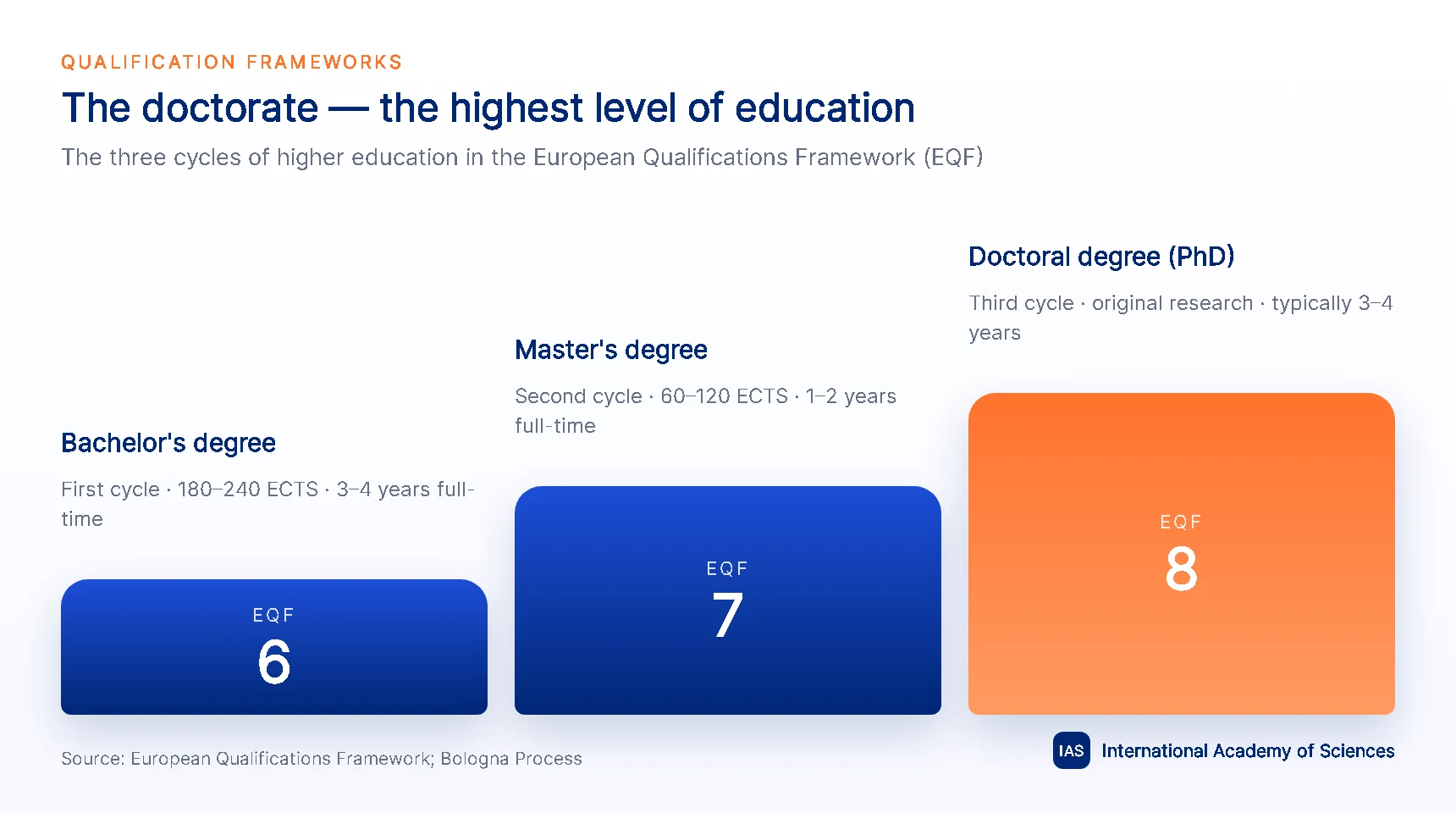
- EQF 8 the highest level of the European Qualifications Framework
- 3–4 years typical duration of full-time doctoral research; part-time study takes longer
- 1 dissertation an original contribution to knowledge, defended in public before independent examiners
The stages of a doctorate
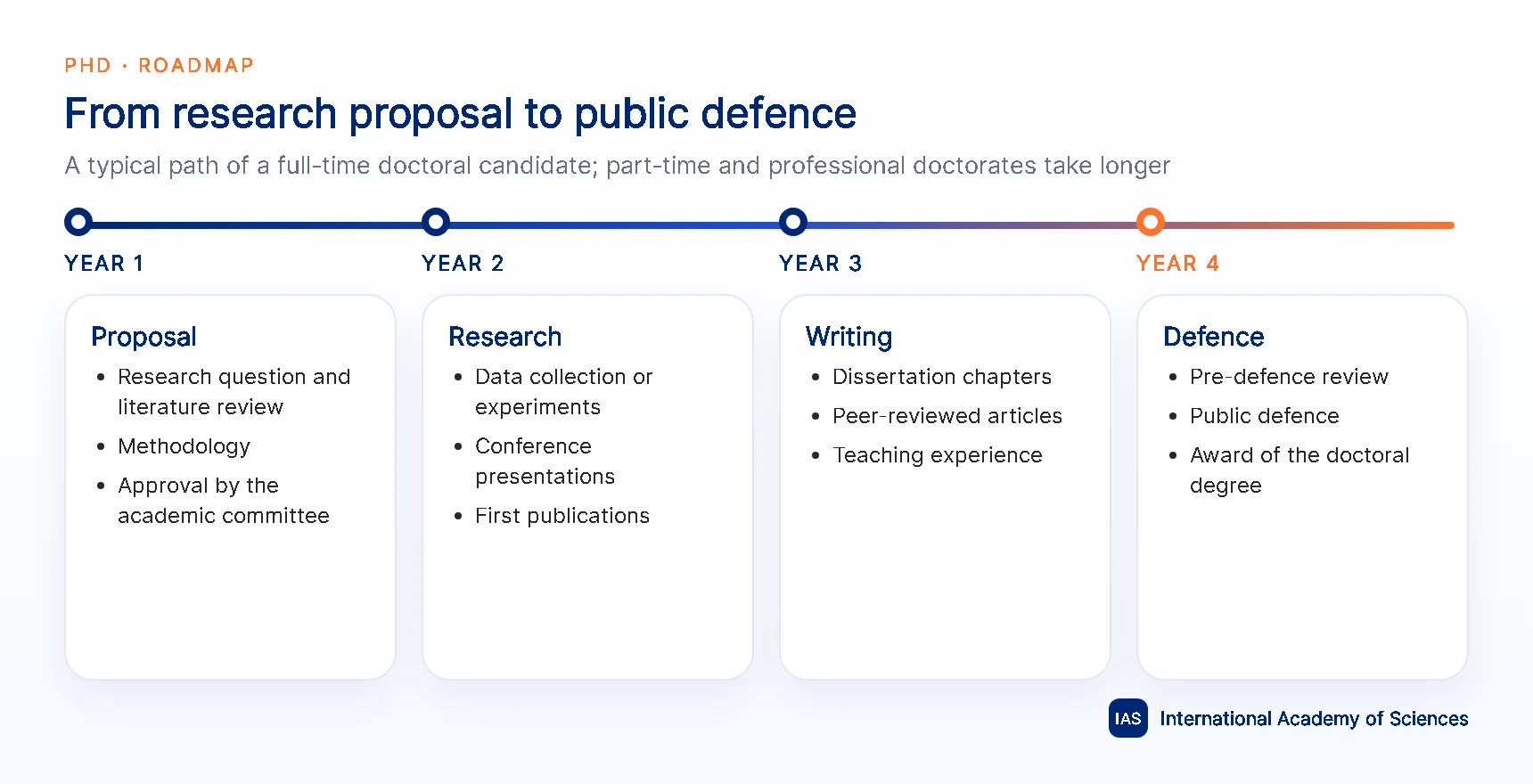
Doctoral research usually follows four stages. In the first year the candidate formulates the research question, studies the literature, designs the methodology and has the research plan approved by an academic committee. The second year is devoted to the research itself: data collection, fieldwork or experiments, the first conference presentations and publications. In the third year the candidate writes the dissertation chapters, publishes peer-reviewed articles and often gains teaching experience. The fourth year brings the pre-defence review, the public defence and the award of the doctoral degree.
Supervision and academic support
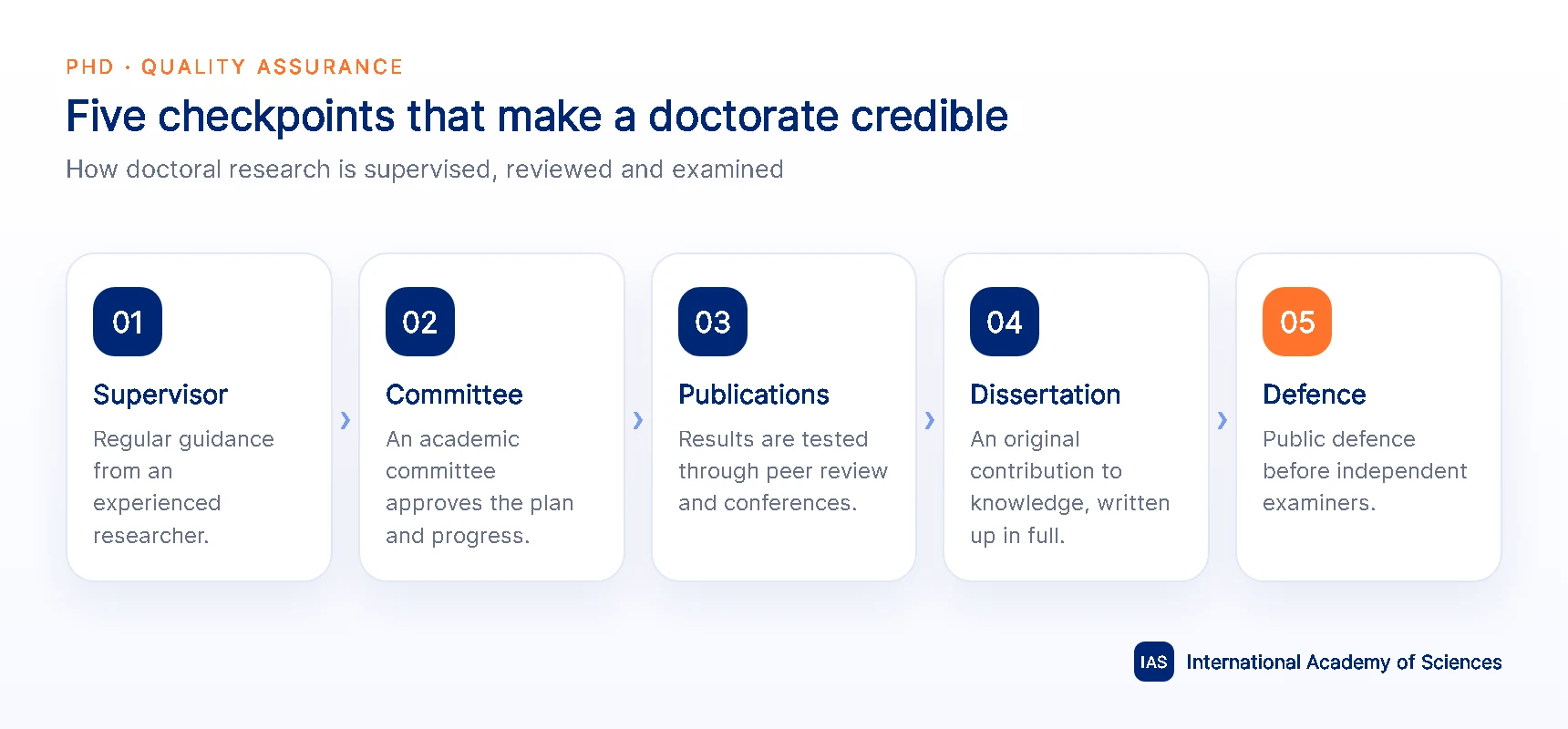
Every doctoral candidate works with an experienced supervisor, and in many cases with a co-supervisor from another institution or country. The supervisor helps to shape the research question, choose methods, plan the work and prepare publications. An academic committee reviews progress at key points. The Academy provides advice on research proposals, research ethics and quality assurance, and organises academic forums, conferences and publication opportunities where candidates can present and test their results.
Individual research tracks
Doctoral research is always individual: the topic grows from the candidate’s interests and experience. Typical areas include economics and public policy, management and leadership, finance and audit, law and international law, mediation and conflict resolution, education, sociology and psychology, and technology including artificial intelligence. Multidisciplinary and cross-institutional projects are encouraged.
Key advantages
- Individual research tracks tailored to the candidate’s interests.
- Participation in international conferences and publications.
- Multidisciplinary collaboration and cross-institutional research.
- Support for grant applications and funding opportunities.
- Development of academic and teaching skills.
Formats for working professionals
Many of our candidates are experienced professionals who continue to work while doing research. For them, the programme combines distance learning with intensive periods of academic mentorship, online supervision meetings and participation in seminars. Applied research topics drawn from the candidate’s own professional field are welcome — provided they meet the academic standards of originality, rigour and contribution to knowledge.
Research ethics and academic integrity
A doctorate is only as valuable as the trust placed in it. Candidates follow clear rules on research ethics, informed consent, data protection and correct citation; texts are checked for originality, and the use of digital tools, including artificial intelligence, must be disclosed and must never replace the candidate’s own analysis and writing. These standards protect both the candidate and the reputation of the degree.
Admission requirements
- A master’s degree in a relevant field (or an equivalent qualification).
- A research proposal describing the question, its relevance and the planned methods.
- An academic CV; publications or practical contributions are an advantage.
- An interview with the academic committee.
Applicants with a significant research or leadership background, published work or nomination by an academic institution are considered individually. Our managers and academic advisers will help you prepare the proposal and the application.
To discuss admission, the choice of field and the documents you need, send a request through the website or contact the Academy’s managers — we will help you choose the programme and format that fit your goals.